Duration
About 4 hours
You set every stage timing from the professor panel, so it fits one block or splits across two sessions.
Corporate Finance Simulation
The Finsimco Corporate Finance Simulation gives each student a 400 million dollar expansion to fund at a listed manufacturer. They choose the capital structure and rank the projects at their own cost of capital, and the cost of equity answers back every time debt goes up.
Duration
You set every stage timing from the professor panel, so it fits one block or splits across two sessions.
Format
Each student holds the capital structure, investment and payout roles in turn and submits one financing plan.
Level
Adjustable: a fixed cost of debt and a set project list, up to a rating grid, a covenant and a rate move.
Professor tools
Manage students, adjust stage timings, control progression and monitor individual inputs.
Prerequisites
Students need present value and net present value. Cost of equity, WACC and the tax shield are built up inside.
Delivery
The web-based simulation supports in-person, remote, blended and homework-supported delivery.
Assessment
Every submission is individual, so the structure, the project ranking and the review answers export per student.
Course fit
Designed for Corporate Finance, Financial Management, Business Finance and Managerial Finance courses.
The topics a corporate finance module has to cover: the weighted average cost of capital, Modigliani-Miller propositions one and two, the interest tax shield, costs of financial distress, net present value and project ranking and payout policy as a signal.
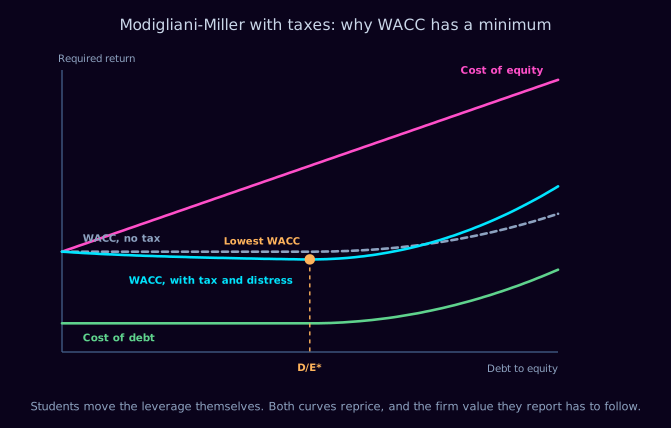
The diagram the session runs on. Debt looks cheap because its line sits below everything else, and the simulation prices the part students leave out: every unit of leverage raises the cost of equity by enough to cancel the saving, which is why the no-tax weighted average is flat. An optimum only appears once the things Modigliani and Miller assumed away are put back, and the student has to say which of them they are relying on.
Written to drop into your module descriptor without rewriting. On completing the simulation, your students will be able to:
Each student runs the finance function alone, holding the capital structure, investment and payout roles in turn. All three want something different from the same 400 million dollars, and only one plan goes to the board.
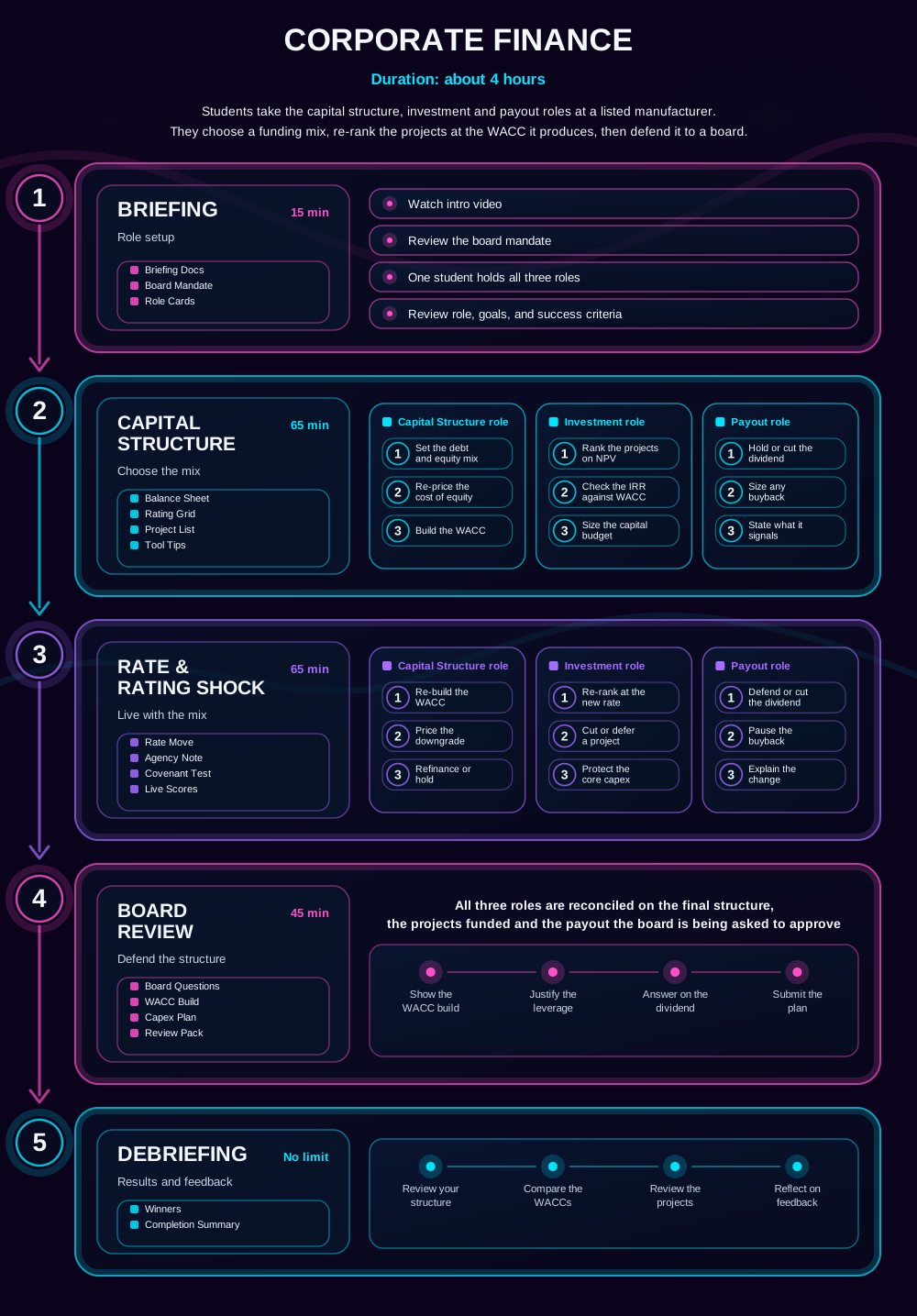
The gameflow every student sees before they start. The three roles come into play during the structure and the shock; briefing, the board review and the debrief are worked as a single view. Materials arrive stage by stage: board mandate and role cards at briefing, then the balance sheet, rating grid and project list for the structure, then the rate move, agency note and covenant test once the shock lands.
Students choose how much of the expansion is funded with debt and how much with equity, and find that the cost of equity is not a constant they get to keep.
Students rank the expansion projects on net present value at whatever discount rate the structure produced, rather than at the rate that made the favourite look good.
Students decide what happens to the dividend and the buyback while the firm is levering up, and answer for what the market reads into it.
Five stages. Students choose a funding mix, rank projects at the cost of capital it produces, then find out what a rate move and a rating action do to both.
Briefing Docs · Board Mandate · Role Cards
Briefing
Students watch the intro video, review the board mandate and take on all three roles, checking the size of the expansion, the rating the board wants to protect and the success criteria before any funding is chosen.
Balance Sheet · Rating Grid · Project List · Tool Tips
Capital Structure
The plan gets built. Working as capital structure, the student picks the funding mix and watches the cost of equity re-price against it; as investment, ranks the expansion projects at the resulting discount rate; as payout, decides what happens to the dividend while leverage is rising. The plan is submitted with the WACC build shown.
Rate Move · Agency Note · Covenant Test · Live Scores
Rate & Rating Shock
Rates rise 150 basis points and the agency puts the credit on negative outlook, which lifts the cost of debt as well as the cost of equity. The interest cover covenant tightens. Projects that cleared the old hurdle no longer clear the new one, and the dividend the student promised has to be paid out of a smaller surplus.
Board Questions · WACC Build · Capex Plan · Review Pack
Board Review
Students are asked why this mix rather than one notch either side, what the cost of equity did when leverage rose, which projects were cut and why, and whether the dividend is being funded by the business or by the new debt.
Winners · Completion Summary
Debriefing
Students review their own plan, compare capital structures across the cohort, revisit the projects that moved when the discount rate changed and reflect on the feedback. Winners and the completion summary give you a structure for the discussion.
The student interface carries the structure, the projects and the reasoning. The professor panel carries the timeline, the controls and every individual plan.
Students work mix by mix, with the cost of equity, the cost of debt and the weighted average they produce together sitting side by side, and a written reason required for the structure chosen and for each one rejected.
The two net present value columns are the whole exercise. Nothing about the projects changed; the discount rate did, and three of the six no longer clear it.
Your view. Adjust any stage timing, start or stop the session, and watch the leverage each student chose, the cost of capital it produced and how much capex survived it.
Explore the student and professor experience, and discuss timing, setup and syllabus fit.
It works best once students can compute a net present value and need to find out where the discount rate comes from.
Present value, net present value and the idea that equity and debt have different required returns. The cost of equity, the WACC and the tax shield are computed inside the activity.
Mid module, typically weeks five to nine, once capital budgeting is done and capital structure begins.
Dividend policy, mergers and acquisitions, real options, distress and restructuring, and any assessment asking students to recommend a capital structure.
The corporate finance course guide sets out where it sits in a full module.
The three mistakes students make on this case, and what each one gives you in the debrief. Our simulations are designed around them: read the learning science behind it.
1
Adding debt lowers the average of the two costs only if the equity cost stays where it was, and it never does. Students build a WACC that falls monotonically with leverage, recommend the most levered structure available, and are then shown the same calculation with Proposition two applied. Watching their own WACC line flatten is what makes the proposition stop being a formula.
2
The project ranking is done first, the structure second, and the discount rate quietly becomes whatever makes the preferred capex clear. The simulation forces the order the other way: the structure produces the rate, and the rate re-ranks the projects, sometimes removing the one the student had already argued for.
3
Cutting a dividend feels like an admission of failure, so students hold it while leverage rises and the surplus shrinks. Paying a dividend with borrowed money is a recognisable pattern and the board asks about it directly, which is usually the first time a cohort treats payout as a signalling decision rather than a cash one.
The debrief runs itself. Every student sees their results, the cohort comparison and the decisions that produced them, with nothing for you to prepare. If you would rather lead the discussion, these questions work straight from a slide, and they use what your cohort actually did.
Assessment is optional. Run the simulation ungraded as an applied activity, or use platform data as supporting evidence. Every student generates a capital structure, a WACC build, a ranked capital budget, written rationales and a board plan. Because the simulation is single-player, every input belongs to one named student, so there is no group-work marking to untangle. All of it exports as CSV or PDF, per student, so you can assess reasoning rather than a result.
On generative AI: written rationales are exactly what marking teams now worry about. Because every rationale here is tied to a structure the student chose inside the platform, with the WACC build and the project ranking sitting next to it, the reasoning can be checked against the evidence rather than taken on trust.
93% of students rate Finsimco simulations Excellent, across more than 30,000 responses.
Teaching notes, a setup and facilitation guide and a gameflow diagram come with it, and we support your first delivery directly.
Run it ungraded the first time. Assessment is optional and can be added once you have seen how your cohort responds.
Pause or stop at any point and resume later without losing submitted data, so an overrun costs you a timetable slot, not the activity.
Read what lecturers say.
Ron Tuninga, Managing Director for EMEA at AACSB, and Victor Hedenberg, Membership Director at AMBA, on why simulation-based learning belongs in business education. Watch both interviews.
If this one is not quite right for your module, these are the closest alternatives.

Ranking competing projects under a hard constraint.
Learn MoreWhere the optimum sits and what moves it.
Learn More
Negotiating a full loan package, term by term.
Learn More
Discounting, compounding and what a cash flow is worth.
Learn MoreA one-page summary of this simulation, covering stages and timings, roles, concepts, learning outcomes and the debrief questions, plus a full sample teaching pack from one of our live simulations, so you can see exactly what you would be running.
During the call, we can: