Duration
About 3 hours
You set every stage timing from the professor panel, so it fits one block or splits across two sessions.
Bootstrapping vs VC Funding Simulation
The Finsimco Bootstrapping vs VC Funding Simulation makes each student choose in year one between a bigger slice and a bigger pie. Six years then run, to show which one they were actually offered.
Duration
You set every stage timing from the professor panel, so it fits one block or splits across two sessions.
Format
Each student holds the growth, capital and ownership roles in turn and submits one funding path.
Level
Adjustable: two clean paths on fixed terms, up to a participating preference, a down round and an early buyer.
Professor tools
Manage students, adjust stage timings, control progression and monitor individual inputs.
Prerequisites
No prior knowledge. Dilution, preference stacks, option pools and funding requirements are taught inside.
Delivery
The web-based simulation supports in-person, remote, blended and homework-supported delivery.
Assessment
Every submission is individual, so the path chosen, the growth plans and the review answers export per student.
Course fit
Designed for Entrepreneurship, Entrepreneurial Finance, Venture Capital and Small Business Finance courses.
The topics a bootstrapping vs vc funding module has to cover: dilution and fully diluted ownership, the growth a round has to buy, preference stacks and what a founder receives, option pools, funding the growth the business can absorb and comparing paths on the distribution of outcomes.

Two paths for the same company over six years, both valued at four times revenue. The bootstrapped business grows to eighteen million dollars of revenue and the founder still owns eighty-eight per cent, so the stake is worth sixty-three million. The venture-funded business raises three rounds, grows to eighty-eight million, and the founder owns twenty-one per cent, worth seventy-four. The lines cross during year five, which makes dilution a question about the growth rate rather than about the percentage.
Written to drop into your module descriptor without rewriting. On completing the simulation, your students will be able to:
Each student runs the company alone, holding the growth, capital and ownership roles in turn. All three want something different from the same business, and only one path is taken.
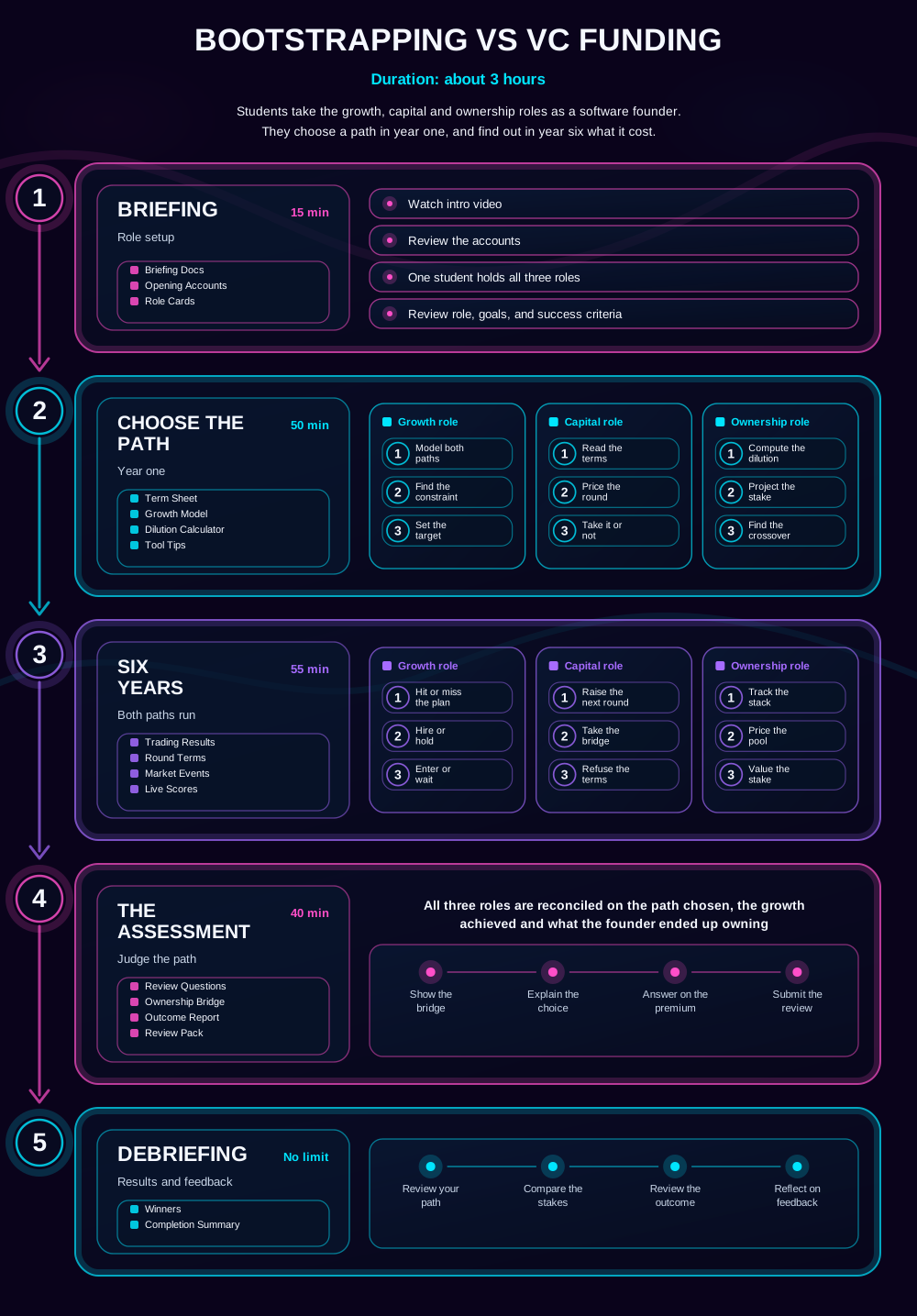
The gameflow every student sees before they start. The three roles come into play while the path is chosen and through the six years; briefing, the assessment and the debrief are worked as a single view. Materials arrive stage by stage: opening accounts and role cards at briefing, then the term sheet, growth model and dilution calculator, then the trading results, round terms and market events.
Students set how fast the business grows, which is the only variable that decides whether the capital was worth taking.
Students decide what to raise, when and on what terms, including the rounds not taken and what that costs in growth.
Students track what the founder actually owns after each round and what it is worth, which is the number the whole argument is about.
Five stages. Students choose a funding path in year one and run six years of consequences.
Briefing Docs · Opening Accounts · Role Cards
Briefing
Students watch the intro video, review a two million dollar revenue software business that is profitable, growing at seventy per cent and has a term sheet on the table, and take on all three roles before the path is chosen.
Term Sheet · Growth Model · Dilution Calculator · Tool Tips
Choose the Path
The path is chosen in year one, before anything is known. Working as growth, the student models what each path can actually grow at; as capital, reads a term sheet with a one times preference and an option pool; as ownership, computes the growth premium the money would have to deliver to pay for itself.
Trading Results · Round Terms · Market Events · Live Scores
Six Years
Six years run on the chosen path and the other one is tracked alongside it. A competitor raises a large round, a bootstrapped business turns down an order it cannot fund, a funded business grows faster and burns more, and year four brings a down round for one of them.
Review Questions · Ownership Bridge · Outcome Report · Review Pack
The Assessment
The path is assessed. Students are asked what growth premium the capital actually delivered, what their stake was worth against the other path, whether the preference stack took anything, and whether they would make the same choice knowing only what they knew in year one.
Winners · Completion Summary
Debriefing
Students review their own path, compare founder stakes across the cohort, revisit the decisions that separated them and reflect on the feedback. Winners and the completion summary give you a structure for the discussion.
The student interface carries the paths, the terms and the ownership. The professor panel carries the timeline, the controls and every individual ownership bridge.
Students work year by year, with the growth each path can support, the ownership that follows and the founder's resulting value side by side, and a written reason required for the path chosen.
The comparison column is the one that stings. The path not taken is tracked all the way through, and it is ahead for the first four years.
Your view. Adjust any stage timing, start or stop the session, and compare the path each student chose with what their stake was finally worth.
Explore the student and professor experience, and discuss timing, setup and syllabus fit.
It works best as the session that settles an argument with arithmetic.
What equity and a valuation multiple are. Dilution, preference stacks and option pools are explained inside the activity.
Mid module, typically weeks four to eight, after valuation has been introduced.
Later-stage funding, exits, secondary markets, founder agreements, and any assessment asking students to recommend a financing strategy.
The funding path course guide sets out where it sits in a full module.
The three mistakes students make on this case, and what each one gives you in the debrief. Our simulations are designed around them: read the learning science behind it.
1
Giving away seventy-eight per cent of a company that becomes thirty times larger is a good trade, and students argue about the percentage without computing what the money bought. The crossover chart is usually the first time the question is asked properly.
2
Money only converts into growth if the business has somewhere to put it. Students who raise a large round into a business that cannot hire fast enough burn it on experiments and dilute for nothing.
3
The funded path has a much wider distribution, including the outcomes where the preference stack takes everything the founder has. Comparing two central cases hides the fact that one of them has a tail the other does not.
The debrief runs itself. Every student sees their results, the cohort comparison and the decisions that produced them, with nothing for you to prepare. If you would rather lead the discussion, these questions work straight from a slide, and they use what your cohort actually did.
Assessment is optional. Run the simulation ungraded as an applied activity, or use platform data as supporting evidence. Every student generates a path choice, growth plans, funding decisions, an ownership bridge and rationales. Because the simulation is single-player, every input belongs to one named student, so there is no group-work marking to untangle. All of it exports as CSV or PDF, per student, so you can assess reasoning rather than a result.
On generative AI: written rationales are exactly what marking teams now worry about. Because every rationale here is tied to a projection the student recorded inside the platform in year one, the reasoning can be checked against the evidence rather than taken on trust.
93% of students rate Finsimco simulations Excellent, across more than 30,000 responses.
Teaching notes, a setup and facilitation guide and a gameflow diagram come with it, and we support your first delivery directly.
Run it ungraded the first time. Assessment is optional and can be added once you have seen how your cohort responds.
Pause or stop at any point and resume later without losing submitted data, so an overrun costs you a timetable slot, not the activity.
Read what lecturers say.
Ron Tuninga, Managing Director for EMEA at AACSB, and Victor Hedenberg, Membership Director at AMBA, on why simulation-based learning belongs in business education. Watch both interviews.
If this one is not quite right for your module, these are the closest alternatives.
A one-page summary of this simulation, covering stages and timings, roles, concepts, learning outcomes and the debrief questions, plus a full sample teaching pack from one of our live simulations, so you can see exactly what you would be running.
During the call, we can:


