90% of hiring managers prefer simulation-generated shortlists
A clearer signal beats a stack of resumes when you need to decide who is worth moving forward.

For talent attraction and hiring leaders
Choose from 15 role-specific templates (M&A, Consulting, Sales) or design a fully custom simulation that replicates the tasks your new joiners will perform.
Generic tests and interviews don't replicate the job, so strong talkers can pass while true performers get overlooked.
Our solution: choose from role templates or co-design a custom simulation that mirrors your real workflows, tasks, and challenges. Candidates love the experience and you receive performance data.
00 sec

See how the simulation works. Align on the role, what strong performance looks like, and what you want to assess.
Start from a template or build from scratch. We map your real workflows, scenarios, and decision points into the simulation, add scoring, and prepare it for launch.
Run live online or in-person simulations. Instant performance insights help you identify top talent and focus only on the candidates who truly stand out.
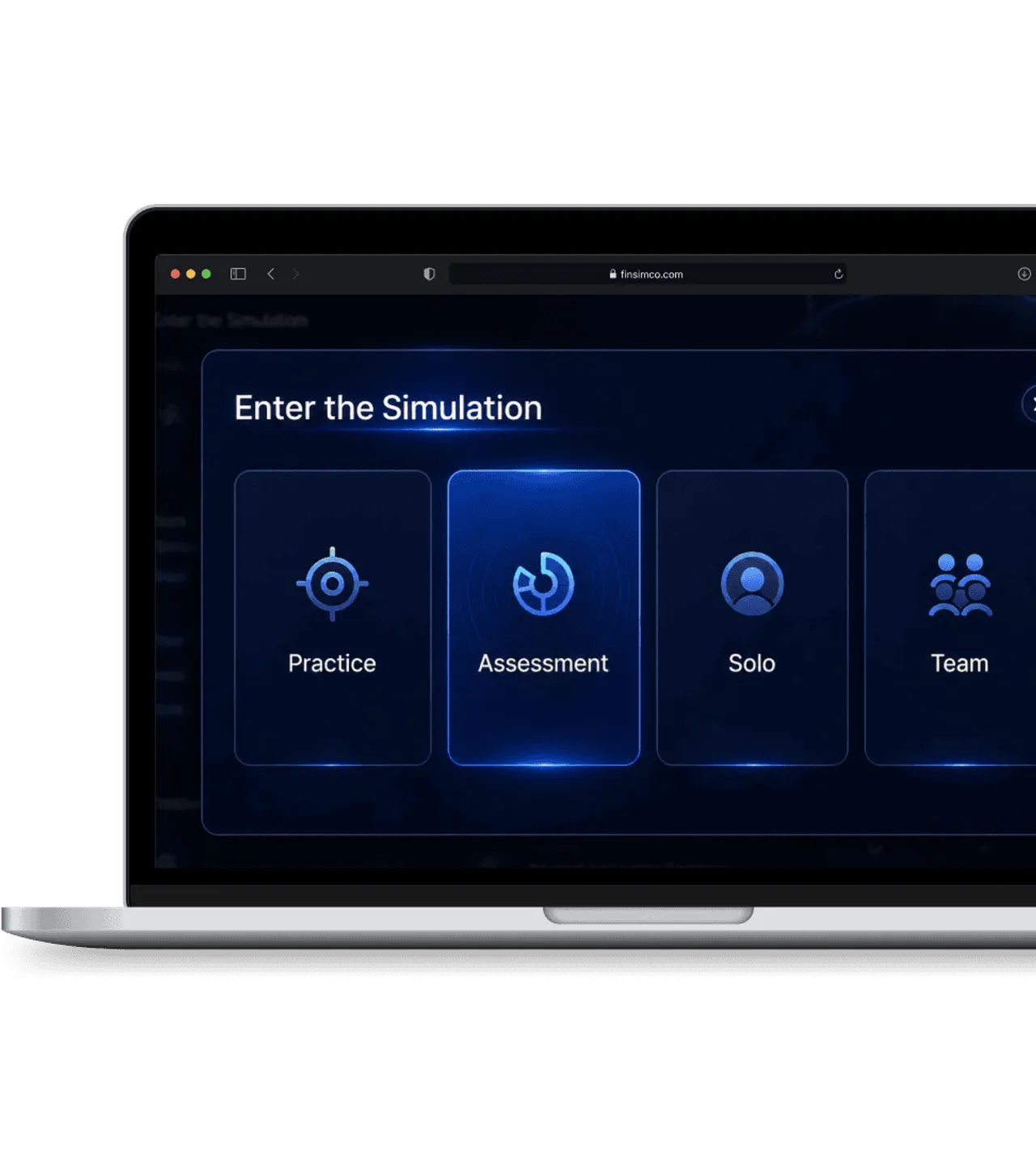
Our platform allows you to build assessments directly mirroring your organization's work. Mix and match options for online or in-person challenges within your industry, assessing both technical and behavioral skills.

Use the simulation for initial screening. Your branded experience attracts more candidates while your team focuses only on those who have already proven they can perform.
Result
3x more interest compared to normal job ad
Use the simulation to assess final-stage candidates, where your team assesses live. Objective data ensures a functional fit and gives you the confidence to select proven performers.
Result
85% of students rate the experience excellent
Not sure which is best? Book a call and we'll recommend the right option for your goal.
With a simulation that mirrors real challenges, you transform recruitment into an unforgettable experience. Candidates walk away feeling inspired and valued, positioning your company as an employer of choice. When candidates step into the job, they get excited about your specific career path and can either confirm their interest or rethink their career path entirely - saving you and them costly misalignment later.

A strong assessment simulation also includes a career-education component. This matters because it allows you to set a high bar, resulting in top candidates staying engaged while weaker ones self-select out. We work with you to design simulations that give candidates a clear view of what the role actually involves, how the work is done, and what success and career growth look like.
For teams hiring larger early-career cohorts, we run a free 2-hour simulation with your team. After the session, you receive an assessment report showing each of your team member's performance.
When hiring is high-stakes, you need signal you can trust. These simulations surface observable job behavior and turn it into structured output, so your team can make decisions faster and more consistently. Because the simulation mirrors your real work, you get more than a test score: data on communication, collaboration, judgment, drive, and whether someone actually gets the job done in your environment.
A clearer signal beats a stack of resumes when you need to decide who is worth moving forward.
That clarity helps the right candidates lean in, and helps mismatched candidates opt out earlier.
Start from a proven template for speed, then tailor the tasks and scoring to your role.

Because candidates work through realistic tasks live - individually and in teams - you get a 360-degree assessment on how they communicate, collaborate, handle pressure, show drive, and whether they actually get the work done. That helps you make faster hiring decisions, improve shortlist quality, and streamline the process when time-to-hire is critical. For larger hiring programs, it also supports stronger fill rates without increasing internal workload. We handle the design, build, and delivery, so your team does not need the manpower to create this internally. The result is a more credible, high-quality assessment experience that candidates value, strengthens your employer brand, and reduces the risk of hiring people who do not fit the job. The evidence behind what we measure, and why it predicts performance, is on [our assessment science page](/simulation-platform/assessment-science).
A quick comparison of what you get from a live, job-realistic simulation versus interviews and generic tests.
| Our Assessments | Traditional Assessments | |
|---|---|---|
| Evaluating Skills | Job-real tasks: candidates complete work that mirrors the role, not abstract puzzles. | Limited reach: interviews and generic tests often measure confidence, polish, or test-taking skill. |
| Decision Confidence | Observed behavior: you see how candidates analyze, decide, communicate, and adjust under pressure. | Ad-hoc presence: decisions depend heavily on interviewer interpretation and fragmented evidence. |
| Candidate Experience | Engaging simulation: candidates learn the role while showing what they can do. | Time-intensive process: candidates often repeat interviews without gaining a clear view of the job. |
| Risk Mitigation | Evidence-based: work samples and scoring reduce the chance of hiring someone who cannot perform. | Mixed quality: resumes and interviews can hide gaps until after the hire. |
| Flexibility | Template or custom: use a proven role template or tailor a simulation to your workflow. | Limited: off-the-shelf assessments rarely reflect your specific work environment. |
| Results | Structured output: reports show strengths, risks, and interview follow-ups. | Limited insight: teams often leave with notes, opinions, and inconsistent scoring. |
If you want role-specific tasks, objective scores, and work samples instead of gut feeling, then start with a proven role template, tailor it to your team, and make hiring decisions from job-realistic evidence.

No. You can start from a role template and tailor only what matters, or co-design a fully custom simulation.
It depends on how custom you want it. Template-based launches can be ready within 1 week; fully custom builds take longer and require subject-matter expert input.
For a 360-degree view, you need a team-based element as well. That said, team-based simulations include many stages where candidates work individually, analysing data and making their own decisions.
We handle the design, setup, scoring logic, and delivery of the simulation with you.
Your team is typically involved in defining what good looks like, reviewing the scope, and deciding how the outputs should support hiring decisions. After that, we do the heavy lifting.
For early-stage, large-scale assessments, around 2 hours is ideal. For final-round assessment centres, they typically last 2 to 4 hours.
Early stage: Unlimited. Candidates sign up and complete the simulation online. Many teams run multiple sessions or parallel groups to scale across campuses.
Final-round assessment centres: Smaller groups where you want to be more involved. These can run online or in person.
Early stage: Reduce screening load and prioritise who gets interviews
Late stage: Final quality check when stakes are high
Yes. Most clients reuse and iterate over time with new scenarios, updated rubrics, and refreshed prompts.
You can, but most teams prefer a performance breakdown: benchmark, strengths, risks, and role-fit notes to guide interviews.
Yes. Many teams run a short calibration round so hiring managers align on "what good looks like" before rolling it out broadly.
No. To get a true 360-degree view, the simulations include live team interaction where candidates must communicate, collaborate, and make decisions together in real time.
While a candidate could technically paste part of a task into an AI tool, it does not help. They still need to explain their thinking, align with teammates, and adapt as the scenario evolves. This is where communication, collaboration, and real drive become visible.
The simulation is designed to assess how candidates behave and contribute, not just their analytical output, so any mismatch between AI-generated input and real performance is immediately apparent.
Because the simulation is live and job-realistic, candidates do not just give polished answers - they have to communicate, collaborate, make decisions, respond to new information, and move the work forward.
That gives you structured evidence on how someone communicates, works with others, handles pressure, shows initiative, and whether they actually get the job done.
The simulations are live, team-based, and video-recorded. AI analyses candidates' verbal communication and individual interface inputs. While outside help is theoretically possible, it is unlikely to go undetected; someone who only excels in isolated analytical tasks would raise a clear signal.
Yes. Unlike shared simulations, the student data and performance insights from your simulation are exclusive to you. No other company sees this information.
Candidate participation and data sharing are opt-in, and all data handling follows GDPR and relevant privacy requirements.
For teams hiring larger early-career cohorts, we offer a free 2-hour live simulation session for 8 participants, managed by us with no setup required on your side.
Your team will experience a simulation the way candidates do. Afterward, you receive the same assessment outputs recruiters use.
It is the fastest way to see:


Book a short call and we will map your role to the right starting point, whether that is a proven template you can tailor quickly or a fully custom simulation.
You will leave knowing what assessment data you will get and what it would take to launch.