Duration
About 4 hours
You set every stage timing from the professor panel, so it fits one block or splits across two sessions.
Asset Liability Management Simulation
The Finsimco Asset Liability Management Simulation gives each student a bank balance sheet to place on a repricing ladder, including deposits with no contractual maturity. They size a hedge, then a 200 basis point move tests every assumption they made.
Duration
You set every stage timing from the professor panel, so it fits one block or splits across two sessions.
Format
Each student holds the treasury, balance sheet and risk roles in turn and submits one ALCO position.
Level
Adjustable: a parallel shift on fixed assumptions, up to a curve twist, a moving deposit beta and mortgage optionality.
Professor tools
Manage students, adjust stage timings, control progression and monitor individual inputs.
Prerequisites
Students need present value and why bond prices fall when rates rise. Duration and the gap measures are taught inside.
Delivery
The web-based simulation supports in-person, remote, blended and homework-supported delivery.
Assessment
Every submission is individual, so the ladder, the assumptions, the hedge and the review answers export per student.
Course fit
Designed for Asset Liability Management, Bank Management, Financial Institutions, Risk Management and Treasury courses.
The topics an asset liability management module has to cover: the repricing gap and the maturity ladder, net interest income sensitivity, economic value of equity, behavioural maturity of non-maturing deposits, deposit beta and hedging with interest rate swaps.
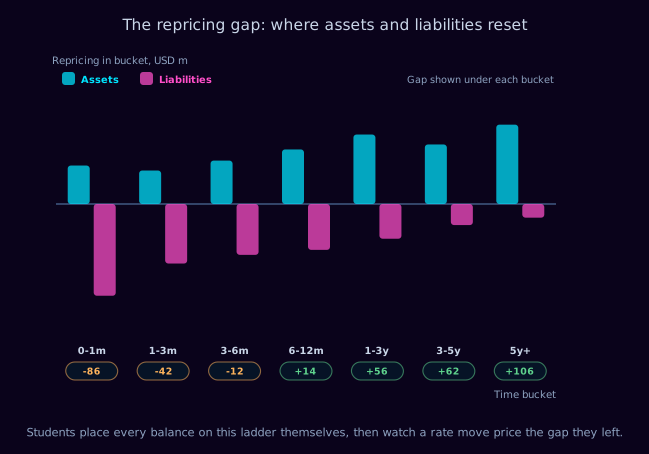
The ladder the committee argues over. Deposits reprice in days and the mortgage book does not, so the short buckets are liability-sensitive and a rate rise lands on earnings almost at once. Further out the position reverses, and that end of the ladder decides the economic value of equity rather than this year's income. Nothing here is purely factual: a checking account has no contractual maturity, so the bucket it sits in is a behavioural assumption the student made and has to defend.
Written to drop into your module descriptor without rewriting. On completing the simulation, your students will be able to:
Each student runs the committee alone, holding the treasury, balance sheet and risk roles in turn. All three want something different from the same balance sheet, and only one position goes to ALCO.
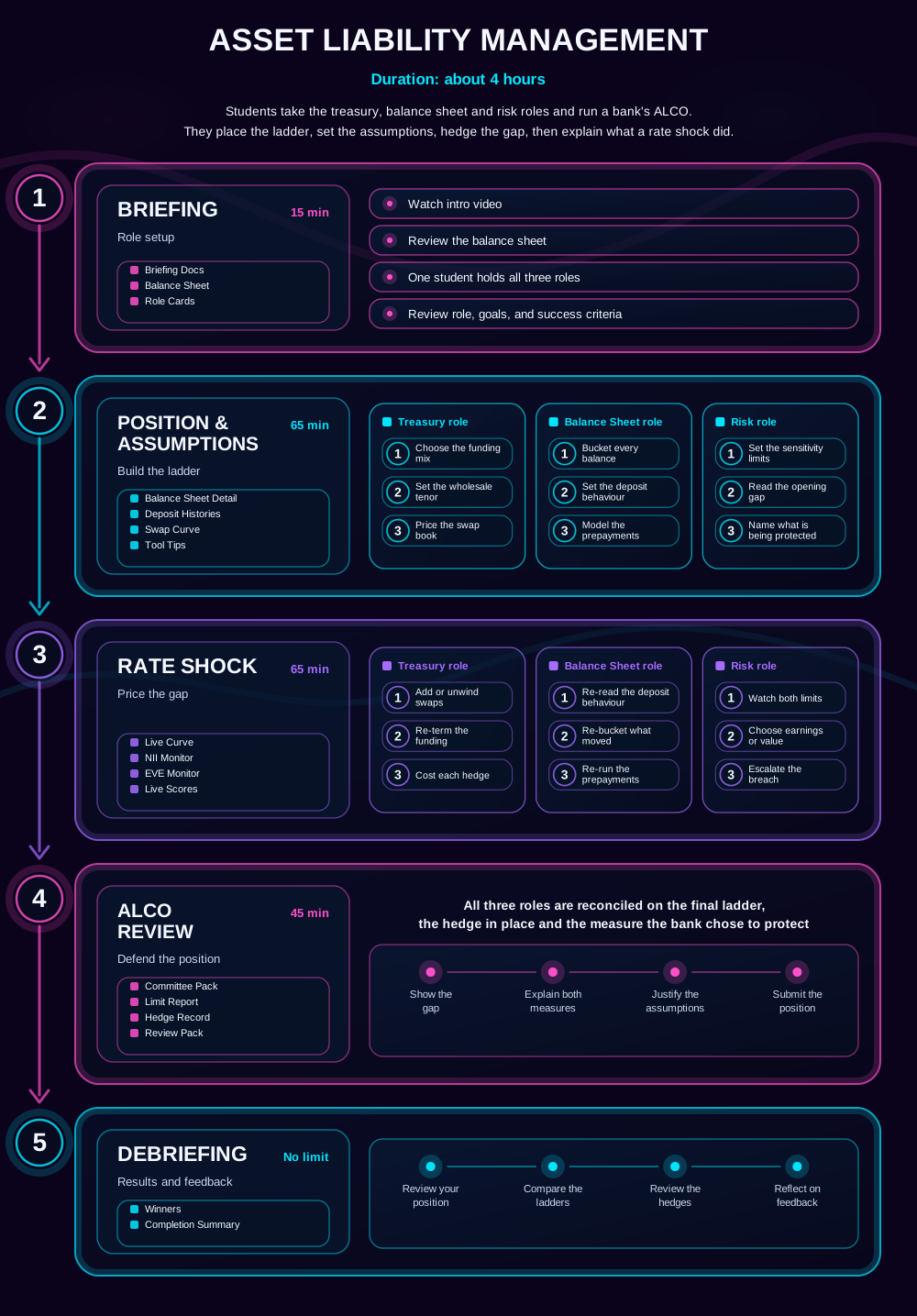
The gameflow every student sees before they start. The three roles come into play during the position and the rate shock; briefing, the ALCO review and the debrief are worked as a single view. Materials arrive stage by stage: balance sheet and role cards at briefing, then deposit histories and the swap curve for the ladder, then the live curve and the two sensitivity monitors once rates move.
Students choose the wholesale funding mix and its tenor, and decide how much of the gap to close with swaps rather than with the balance sheet itself.
Students place every asset and liability in a repricing bucket, including the ones with no contractual maturity, and own the behavioural assumptions that put them there.
Students hold net interest income sensitivity and economic value of equity inside their limits, and say which one the bank is protecting when the two disagree.
Five stages. Students place a balance sheet on a repricing ladder, set the assumptions underneath it, hedge the gap, then explain a shock that moves earnings and value in opposite directions.
briefing docs · balance sheet · role cards
Briefing
Students watch the intro video, review the balance sheet and take on all three roles, checking the risk limits they are bound by, the funding available and the success criteria before anything is placed on the ladder.
balance sheet detail · deposit histories · swap curve · tool tips
Position & Assumptions
The position gets built. Working as treasury, the student picks the funding mix and the tenor; as balance sheet, places every balance in a repricing bucket and sets the behavioural life of the deposits; as risk, reads the gap that produces and states which measure the bank is protecting. The position is submitted with a written assumption for every non-maturing balance.
live curve · NII monitor · EVE monitor · live scores
Rate Shock
Rates move 200 basis points and the curve twists rather than shifting. Deposit beta turns out higher than modelled so funding reprices faster than assumed, prepayments slow on the fixed book, and the two risk measures move in opposite directions. Students hedge, re-bucket and decide which limit to defend.
committee pack · limit report · hedge record · review pack
ALCO Review
Students are asked what the gap actually is, why earnings and value moved in opposite directions, which behavioural assumption the whole position rests on, and what happens to it if the deposits turn out to be shorter than the model says.
winners · completion summary
Debriefing
Students review their own position, compare ladders and hedging approaches across the cohort, revisit the behavioural assumptions that drove the result and reflect on the feedback. Winners and the completion summary give you a structure for the discussion.
The student interface carries the ladder, the two sensitivities and the reasoning. The professor panel carries the timeline, the controls and every individual position.
Students work balance by balance, with the amount, the rate basis and the behavioural life they have assumed sitting side by side, and a written reason required for every item with no contractual maturity.
The two right-hand columns are the whole argument. A bucket that helps net interest income usually hurts economic value, and the student has to say which one the bank is protecting before the committee asks.
Your view. Adjust any stage timing, start or stop the session, and watch both sensitivity measures for every student alongside how much of the gap they have hedged.
Explore the student and professor experience, and discuss timing, setup and syllabus fit.
It works best once students know what duration is and need to see a whole balance sheet exposed to one move.
Present value, the inverse relationship between rates and prices, and what a bank's balance sheet contains. Duration, gaps and the two sensitivity measures are computed inside the activity.
Mid to late module, typically weeks six to ten, once interest rate risk has been introduced on a single instrument and needs to scale to an institution.
Liquidity risk, funds transfer pricing, capital planning, stress testing, and any assessment asking students to appraise a bank's interest rate position.
The asset liability management course guide sets out where it sits in a full module.
The three mistakes students make on this topic almost every time. Recognising them is usually the moment the subject lands, and it is the core of the learning science behind it.
1
Checking accounts have no maturity, so students either put them all in the overnight bucket or leave them out. Both are modelling choices with large consequences, and neither is usually stated as one. Watching the whole gap move because an assumption changed, with no balance having moved at all, is the clearest route into why behavioural modelling is the contested part of ALM.
2
Hedging the earnings number is intuitive: it is this year's profit. Doing it usually lengthens the asset side and worsens economic value of equity, and a cohort that has only been watching one dashboard does not see it until the committee asks. The two measures disagreeing by construction is the single idea the simulation is built around.
3
Students size a swap to close the gap and record the position as hedged. The rate risk has moved to a counterparty, and in exchange the bank has taken on basis risk, collateral calls and a mark to market that moves with the curve. The hedge being a transfer rather than a deletion is something most cohorts only feel once the collateral call arrives.
The debrief runs itself. Every student sees their result, the cohort comparison and the decisions that produced them, with nothing for you to prepare. If you would rather lead the discussion, these five questions work straight from a slide, and they use what your cohort actually did.
Assessment is optional. Run the simulation ungraded as an applied activity, or use platform data as supporting evidence. Every student generates a repricing ladder, a set of behavioural assumptions, a hedge record, written rationales and an ALCO paper. Because the simulation is single-player, every input belongs to one named student, so there is no group-work marking to untangle. All of it exports as CSV or PDF, per student, so you can assess reasoning rather than a result.
On generative AI: written rationales are exactly what marking teams now worry about. Because every rationale here is tied to a balance the student bucketed inside the platform, with the gap and both sensitivity measures sitting next to it, the reasoning can be checked against the evidence rather than taken on trust.
93% of students rate Finsimco simulations Excellent, across more than 30,000 responses.
Teaching notes, a setup and facilitation guide and a gameflow diagram come with it, and we support your first delivery directly.
Run it ungraded the first time. Assessment is optional and can be added once you have seen how your cohort responds.
Pause or stop at any point and resume later without losing submitted data, so an overrun costs you a timetable slot, not the activity.
Read what lecturers say.
Ron Tuninga, Managing Director for EMEA at AACSB, and Victor Hedenberg, Membership Director at AMBA, on why simulation-based learning belongs in business education. Watch both interviews.
If this one is not quite right for your module, these are the closest alternatives.
A one-page summary of this simulation, covering stages and timings, roles, concepts, learning outcomes and the debrief questions, plus a full sample teaching pack from one of our live simulations, so you can see exactly what you would be running.
During the call, we can:


