90% of training is forgotten in 72 hours
The research on this has been clear for decades. What is less understood is the specific condition that changes it.

For training & development programs
Simulation-led training programs where employees work through realistic business scenarios, make decisions under pressure, and build role-specific judgment.
Employees work through realistic scenarios – making real decisions, under real pressure, with real consequences. The kind of practice that actually changes behavior.
And because we handle everything (design, delivery, facilitation), you go from idea to impact without the usual program headache.

74 sec

Set up a call to share your talent development goals. We’ll show you how our approach can address your specific challenges.
We design a program tailored to your needs. This can be simulation-only or a blended program combining technical sessions with applied simulations.
Our team handles delivery, facilitation, and reporting end-to-end. You stay in control without carrying the operational burden.
For teams running larger talent programs, we offer a free 2-hour live simulation session for up to 8 participants.
Your team will experience a simulation the way participants do.
It is the fastest way to see:
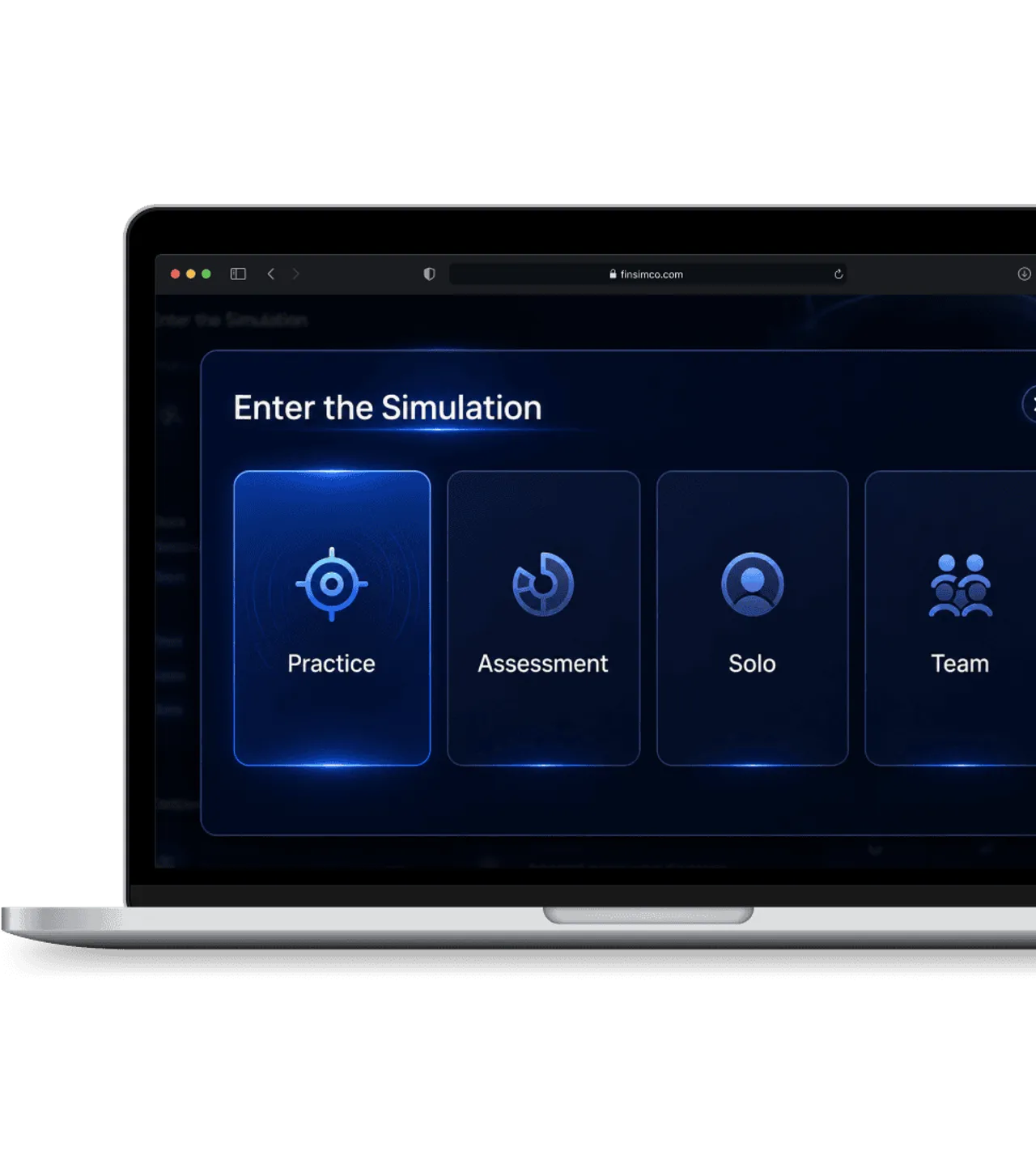

Rather than a complete redesign of your training program managed by us, you can start small by integrating simulations into your existing learning structure, enhancing what you already do without overhauling it
Introduce one simulation into your current process without changing anything else. Track agreed success metrics from day one so you have evidence, not just impressions.
Once you see results, roll out seamlessly at any scale — same quality of experience whether you're running ten participants or a thousand, in-person or virtually.
The research on this has been clear for decades. What is less understood is the specific condition that changes it.
Most training stops at comprehension. Behaviour change requires something else entirely.
Leadership is asking harder questions about training investment. Here is how to answer them with evidence rather than sentiment.

Our simulations are built around realistic business scenarios, not abstract exercises. The scenarios are drawn directly from the work your people do, so the decisions they practice are the decisions they face on the job.
Participants learn by doing, not watching. Each simulation puts them inside a real work situation where they have to think, decide, and act. That is what builds the kind of competency that carries over to the job.
The simulation adjusts to the participant. High performers get harder problems. Others get the guidance they need. Nobody coasts and nobody gets left behind.
You get detailed performance data on every participant: where they excelled, where they hesitated, and where the skill gaps are. That is reporting you can take to a leadership team, not just a post-session survey.
Many challenges require participants to work together across functions. They practise communicating, aligning, and solving problems with colleagues they rarely work alongside.
The program delivers the same quality of experience whether you are running ten participants or a thousand, in-person or virtually, across a single cohort or multiple regions.
We handle everything: scheduling, facilitation, participant communications, and reporting. Your team stays informed and in control without carrying the operational weight.
Employees who feel genuinely challenged and developed stay longer. Not because they are told they are being invested in, but because they can feel it in the work itself.
Every participant leaves a trace. You get performance data tied to specific skills, progress tracked across cohorts, and results you can present to leadership with confidence.

44 SEC
For teams running larger training programs, we offer a free 2-hour live simulation session for 8 participants.
Your team will experience a simulation the way participants do.
It is the fastest way to see:
We’ll discuss logistics with you on a short call beforehand. Our team fully facilitates the session - with no admin or delivery burden on your side.
During the call, we can:

