Duration
About 3.5 hours
You set every stage timing from the professor panel, so it fits one block or splits across two sessions.
Asset Backed Securities Simulation
The Finsimco Asset Backed Securities Simulation gives each student one pool of loans and three tranches to carve from it. A loss scenario then runs in which the pool's average is fine and the middle tranche is gone.
Duration
You set every stage timing from the professor panel, so it fits one block or splits across two sessions.
Format
Each student holds the structuring, rating and investment roles in turn and submits one capital structure.
Level
Adjustable: two tranches on independent losses, up to excess spread, a reserve account and a correlation choice.
Professor tools
Manage students, adjust stage timings, control progression and monitor individual inputs.
Prerequisites
No prior knowledge. Attachment points, subordination, excess spread and default correlation are taught inside.
Delivery
The web-based simulation supports in-person, remote, blended and homework-supported delivery.
Assessment
Every submission is individual, so the structure, the attachment points and the review answers export per student.
Course fit
Designed for Asset Backed Securities, Structured Finance, Fixed Income, Credit Risk and Banking courses.
The topics an asset backed securities module has to cover: tranching and subordination, attachment and detachment points, credit enhancement, excess spread and the reserve account, default correlation and rating a structured note.
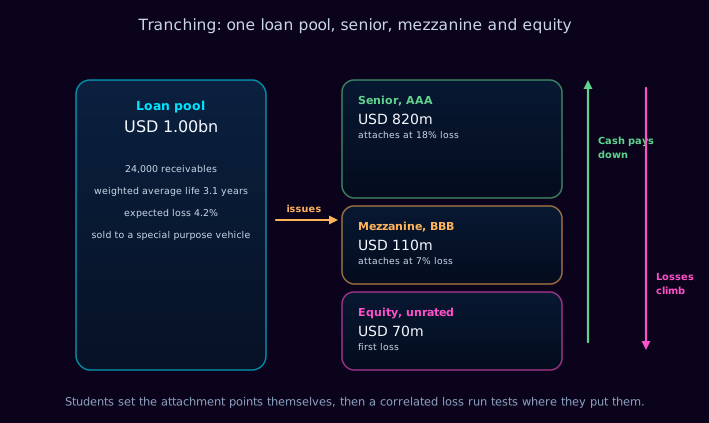
The diagram the asset class is built on. Nothing about any individual receivable is triple-A; the rating comes from the eighteen per cent of losses that have to happen before the senior tranche is touched, which is a statement about structure rather than about borrowers. The attachment points decide everything, and the assumption holding them up is correlation. Independent defaults spread losses thinly and the mezzanine survives; correlated defaults arrive in a cluster and go straight through it, with the pool's expected loss unchanged.
Written to drop into your module descriptor without rewriting. On completing the simulation, your students will be able to:
Each student runs the deal alone, holding the structuring, rating and investment roles in turn. All three want something different from the same pool, and only one structure is submitted.
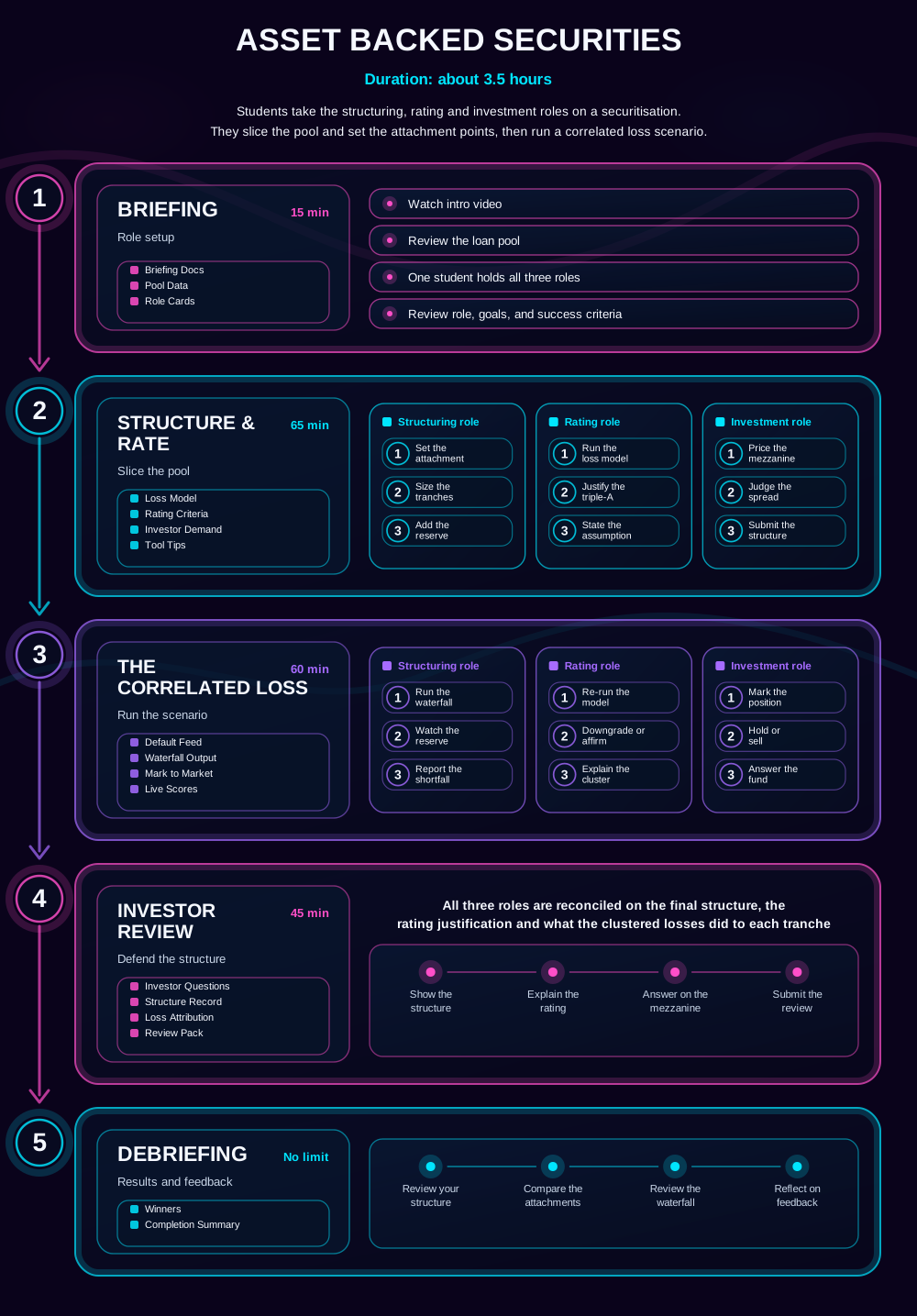
The gameflow every student sees before they start. The three roles come into play during the structuring and the loss scenario; briefing, the investor review and the debrief are worked as a single view. Materials arrive stage by stage: pool data and role cards at briefing, then the loss model, rating criteria and investor demand for the structuring, then the default feed, waterfall output and marks once the losses begin.
Students decide where the attachment points sit, how much subordination the senior tranche needs, and what the excess spread and reserve account are doing underneath.
Students justify a triple-A on a pool of consumer loans, and state exactly which assumption about correlation that rating depends on.
Students decide what the mezzanine is worth given the attachment point and the correlation assumption, and whether the spread pays for the shape of its payoff.
Five stages. Students slice a loan pool into three tranches, justify the ratings, then run a loss scenario where the defaults cluster.
Briefing Docs · Pool Data · Role Cards
Briefing
Students watch the intro video, review the pool of twenty-four thousand receivables and take on all three roles, checking the expected loss, the weighted average life and the success criteria before any tranche is drawn.
Loss Model · Rating Criteria · Investor Demand · Tool Tips
Structure & Rate
The deal gets structured. Working as structuring, the student sets the attachment points for a senior, a mezzanine and an equity tranche on a USD 1bn pool; as rating, runs the loss model and writes the justification for the senior rating; as investment, prices the mezzanine on the spread offered and the protection beneath it. The structure is submitted with the correlation assumption stated.
Default Feed · Waterfall Output · Mark to Market · Live Scores
The Correlated Loss
A regional employer fails and the defaults arrive together rather than spread across the pool. Cumulative losses reach nine per cent against an expected four point two, which is well inside the senior's protection and straight through the mezzanine. The equity is gone in the first six months and the reserve account empties before the excess spread can rebuild it.
Investor Questions · Structure Record · Loss Attribution · Review Pack
Investor Review
Students are asked what the triple-A actually rested on, why a pool performing within two standard deviations of expectation destroyed a tranche, whether the mezzanine spread compensated for that shape, and where they would set the attachment points now.
Winners · Completion Summary
Debriefing
Students review their own structure, compare attachment points across the cohort, revisit the waterfall that separated them and reflect on the feedback. Winners and the completion summary give you a structure for the discussion.
The student interface carries the tranches, the loss model and the reasoning. The professor panel carries the timeline, the controls and every individual structure.
Students work tranche by tranche, with the size, the attachment point and the enhancement supporting it side by side, and a written reason required for the correlation assumption behind every rating.
The mezzanine column is the one that matters. Cumulative losses reached nine per cent, which is inside the senior's eighteen per cent protection and has written the mezzanine down to nothing.
Your view. Adjust any stage timing, start or stop the session, and watch which students assumed independent defaults and what the cluster did to their middle tranche.
Explore the student and professor experience, and discuss timing, setup and syllabus fit.
It works best as the session that explains where a rating on a pool of ordinary loans comes from.
Percentages, probabilities and the idea that a loan can default. Attachment points, subordination, excess spread and correlation are explained inside the activity.
Mid to late module, typically weeks six to ten, once credit risk has been introduced.
Mortgage-backed securities and prepayment risk, collateralised loan obligations, credit derivatives, the 2008 crisis as a case, and any assessment asking students to evaluate a structured credit position.
The asset backed securities course guide sets out where it sits in a full module.
The three mistakes students make on this case, and what each one gives you in the debrief. Our simulations are designed around them: read the learning science behind it.
1
A triple-A tranche contains the same receivables as the equity tranche beneath it. The rating is produced entirely by subordination, and students who cannot name the attachment point supporting it have not understood what they rated.
2
Changing correlation while holding the pool's expected loss constant leaves the senior almost untouched and destroys the mezzanine. It is the single most important input in the structure and the one that appears nowhere in the pool statistics.
3
The mezzanine has a thin, highly non-linear payoff: it is either untouched or gone, with very little in between. Averaging across scenarios produces a price that looks reasonable and misses the shape entirely, which the clustered scenario makes unavoidable.
The debrief runs itself. Every student sees their results, the cohort comparison and the decisions that produced them, with nothing for you to prepare. If you would rather lead the discussion, these questions work straight from a slide, and they use what your cohort actually did.
Assessment is optional. Run the simulation ungraded as an applied activity, or use platform data as supporting evidence. Every student generates a capital structure, attachment points, a rating justification, a mezzanine price and written rationales. Because the simulation is single-player, every input belongs to one named student, so there is no group-work marking to untangle. All of it exports as CSV or PDF, per student, so you can assess reasoning rather than a result.
On generative AI: written rationales are exactly what marking teams now worry about. Because every rationale here is tied to an attachment point the student set inside the platform, with the realised waterfall sitting next to it, the reasoning can be checked against the evidence rather than taken on trust.
93% of students rate Finsimco simulations Excellent, across more than 30,000 responses.
Teaching notes, a setup and facilitation guide and a gameflow diagram come with it, and we support your first delivery directly.
Run it ungraded the first time. Assessment is optional and can be added once you have seen how your cohort responds.
Pause or stop at any point and resume later without losing submitted data, so an overrun costs you a timetable slot, not the activity.
Read what lecturers say.
Ron Tuninga, Managing Director for EMEA at AACSB, and Victor Hedenberg, Membership Director at AMBA, on why simulation-based learning belongs in business education. Watch both interviews.
If this one is not quite right for your module, these are the closest alternatives.
A one-page summary of this simulation, covering stages and timings, roles, concepts, learning outcomes and the debrief questions, plus a full sample teaching pack from one of our live simulations, so you can see exactly what you would be running.
During the call, we can:


