Duration
About 3 hours
You set every stage timing from the professor panel, so it fits one block or splits across two sessions.
Boardroom Negotiation Simulation
The Finsimco Boardroom Negotiation Simulation puts each student on the sell side of a divisional sale with four issues and one counterparty. The board votes once, on whatever comes back.
Duration
You set every stage timing from the professor panel, so it fits one block or splits across two sessions.
Format
Each student holds the preparation, bargaining and board roles in turn and submits one agreed package.
Level
Adjustable: two issues against a known counterparty, up to four issues, a hidden floor and a second bidder.
Professor tools
Manage students, adjust stage timings, control progression and monitor individual inputs.
Prerequisites
No prior knowledge. Reservation prices, the bargaining zone, alternatives and multi-issue trades are taught inside.
Delivery
The web-based simulation supports in-person, remote, blended and homework-supported delivery.
Assessment
Every submission is individual, so the preparation, the offers made and the review answers export per student.
Course fit
Designed for Negotiation, Strategic Management, Corporate Finance and Organisational Behaviour courses.
The topics a boardroom negotiation module has to cover: reservation prices and the best alternative, the bargaining zone, distributive against integrative bargaining, trading across issues of different value, reading a concession pattern and carrying a package through a board.
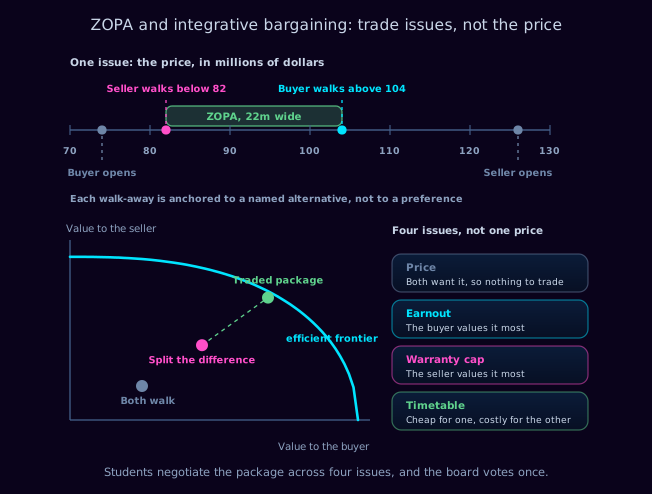
The apparatus every negotiation course opens with, and the figure it rarely reaches. The price line shows a seller who walks below eighty-two and a buyer who walks above a hundred and four, a bargaining zone twenty-two million dollars wide, with opening positions outside it on both sides telling nobody anything. The lower chart plots value to the buyer against value to the seller. Splitting the difference on price lands well inside the frontier. A package trading the earnout against the warranty cap and the timetable sits on it and is better for both.
Written to drop into your module descriptor without rewriting. On completing the simulation, your students will be able to:
Each student runs the negotiation alone, holding the preparation, bargaining and board roles in turn. All three want something different from the same mandate, and only one package is agreed.
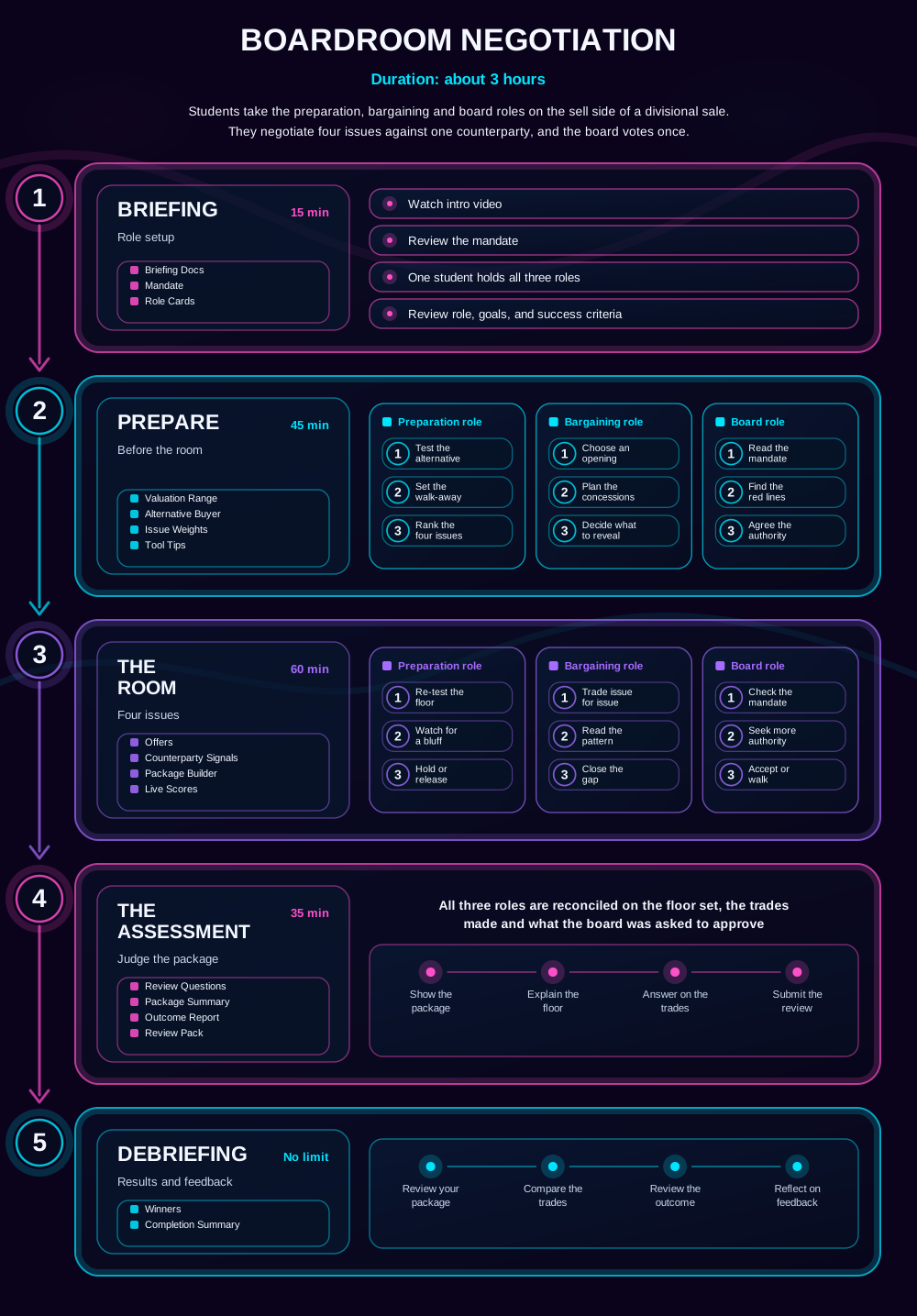
The gameflow every student sees before they start. The three roles come into play during the preparation and the room; briefing, the assessment and the debrief are worked as a single view. Materials arrive stage by stage: mandate and role cards at briefing, then the valuation range, alternative buyer and issue weights for the preparation, then the offers, counterparty signals and package builder once negotiation opens.
Students establish a walk-away anchored to a named alternative rather than a preference, which is the only thing that makes a floor hold under pressure.
Students make and read offers across four issues, where the pattern of concessions says more about the floor than any statement about it.
Students carry a package back to a board that values the issues differently from the negotiator and votes once on the whole thing.
Five stages. Students prepare a floor, negotiate four issues and carry a package to the board.
Briefing Docs · Mandate · Role Cards
Briefing
Students watch the intro video, review a divisional sale with a board mandate, a valuation range and one alternative buyer who has not yet confirmed, and take on all three roles, checking the four issues and the success criteria before any contact is made.
Valuation Range · Alternative Buyer · Issue Weights · Tool Tips
Prepare
The preparation decides most of it. Working as preparation, the student tests whether the alternative buyer is real and sets a floor against it; as bargaining, chooses an opening and plans a concession pattern; as board, establishes which of the four issues the board will not move on at any price.
Offers · Counterparty Signals · Package Builder · Live Scores
The Room
The negotiation runs across four issues. Price is the only one both sides want the same way, so it can only be divided. The earnout, the warranty cap and the timetable are worth different amounts to each side, which is where the joint gains are, and the counterparty mentions a second bidder nobody can verify.
Review Questions · Package Summary · Outcome Report · Review Pack
The Assessment
The package is assessed. Students are asked what their walk-away was anchored to, which issue they gave away first and what it was worth to the other side, how much joint value a straight price split would have destroyed, and whether the second bidder ever existed.
Winners · Completion Summary
Debriefing
Students review their own package, compare trades across the cohort, revisit the moves that separated them and reflect on the feedback. Winners and the completion summary give you a structure for the discussion.
The student interface carries the issues, the offers and the package. The professor panel carries the timeline, the controls and every individual agreement.
Students work issue by issue, with their own value, the estimated value to the other side and the board's red line side by side, and a written reason required for the walk-away.
The frontier column is the one that matters. The current package is six points inside it, and the issue that would close the gap is the one neither side has mentioned.
Your view. Adjust any stage timing, start or stop the session, and compare the price each student agreed with how much joint value their package captured.
Explore the student and professor experience, and discuss timing, setup and syllabus fit.
It works best as the session that moves a class past price.
Nothing specific. Reservation prices, the bargaining zone, alternatives and multi-issue trading are explained inside the activity.
Early to mid module, typically weeks three to seven, once the basic vocabulary has been introduced.
Multi-party negotiation, mediation, cross-border deals, contract design, and any assessment asking students to plan and defend a negotiation.
The boardroom negotiation course guide sets out where it sits in a full module.
The three mistakes students make on this case, and what each one gives you in the debrief. Our simulations are designed around them: read the learning science behind it.
1
A walk-away is only a floor if there is a named alternative at that level. Students who set one because it feels right discover in the second hour that the other side has worked out there is nothing underneath it.
2
Settling the one issue both sides want the same way removes the currency needed to trade the other three. Students who open on price and only then raise the earnout find they are asking for a concession rather than offering an exchange.
3
Eight, then four, then two announces the floor more clearly than any statement could. Students watch the other side's numbers closely and almost never watch the shape of their own.
The debrief runs itself. Every student sees their results, the cohort comparison and the decisions that produced them, with nothing for you to prepare. If you would rather lead the discussion, these questions work straight from a slide, and they use what your cohort actually did.
Assessment is optional. Run the simulation ungraded as an applied activity, or use platform data as supporting evidence. Every student generates a preparation note, offers, a concession pattern, an agreed package and written rationales. Because the simulation is single-player, every input belongs to one named student, so there is no group-work marking to untangle. All of it exports as CSV or PDF, per student, so you can assess reasoning rather than a result.
On generative AI: written rationales are exactly what marking teams now worry about. Because every rationale here is tied to a preparation note the student recorded inside the platform before negotiation opened, the reasoning can be checked against the evidence rather than taken on trust.
93% of students rate Finsimco simulations Excellent, across more than 30,000 responses.
Teaching notes, a setup and facilitation guide and a gameflow diagram come with it, and we support your first delivery directly.
Run it ungraded the first time. Assessment is optional and can be added once you have seen how your cohort responds.
Pause or stop at any point and resume later without losing submitted data, so an overrun costs you a timetable slot, not the activity.
Read what lecturers say.
Ron Tuninga, Managing Director for EMEA at AACSB, and Victor Hedenberg, Membership Director at AMBA, on why simulation-based learning belongs in business education. Watch both interviews.
If this one is not quite right for your module, these are the closest alternatives.
A one-page summary of this simulation, covering stages and timings, roles, concepts, learning outcomes and the debrief questions, plus a full sample teaching pack from one of our live simulations, so you can see exactly what you would be running.
During the call, we can:


