Duration
About 3.5 hours
You set every stage timing from the professor panel, so it fits one block or splits across two sessions.
Business Turnaround Strategy Simulation
The Finsimco Business Turnaround Strategy Simulation hands each student a business with nineteen weeks of cash, a forecast nobody believes and three stakeholders who can each end it. The window is already closing.
Duration
You set every stage timing from the professor panel, so it fits one block or splits across two sessions.
Format
Each student holds the cash, stakeholder and strategy roles in turn and submits one turnaround plan.
Level
Adjustable: one lender on a fixed forecast, up to three stakeholders, a solvent sale and an insolvency trigger.
Professor tools
Manage students, adjust stage timings, control progression and monitor individual inputs.
Prerequisites
Students need to read a cash flow statement. Short-term forecasting and insolvency triggers are taught inside.
Delivery
The web-based simulation supports in-person, remote, blended and homework-supported delivery.
Assessment
Every submission is individual, so the cash forecast, the actions and the review answers export per student.
Course fit
Designed for Business Turnaround, Restructuring, Corporate Strategy, Corporate Finance and General Management courses.
The topics a business turnaround strategy module has to cover: the thirteen-week cash forecast, the turnaround window and when options close, the sequence of turnaround actions, stakeholder negotiation and veto power, buying time against fixing the business and insolvency triggers and directors' duties.
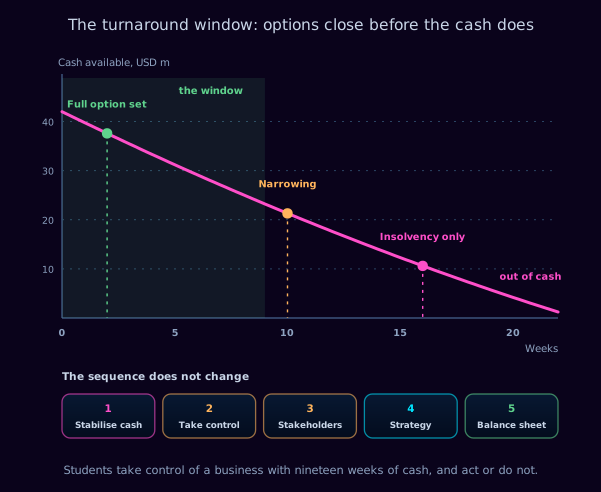
The figure a turnaround professional draws on the first day. The cash line reaches zero in week nineteen, but the useful question is not when the money runs out. In week two there is cash and credibility and the full option set, including a solvent sale. By week ten only cost action and asset disposals remain. By week sixteen only insolvency processes are left and value has collapsed for everyone. The shaded band is where action is both possible and effective. Underneath, the order: stabilise cash, take control, deal with stakeholders, then fix the strategy.
Written to drop into your module descriptor without rewriting. On completing the simulation, your students will be able to:
Each student runs the turnaround alone, holding the cash, stakeholder and strategy roles in turn. All three want something different in the same week, and only one action is taken.
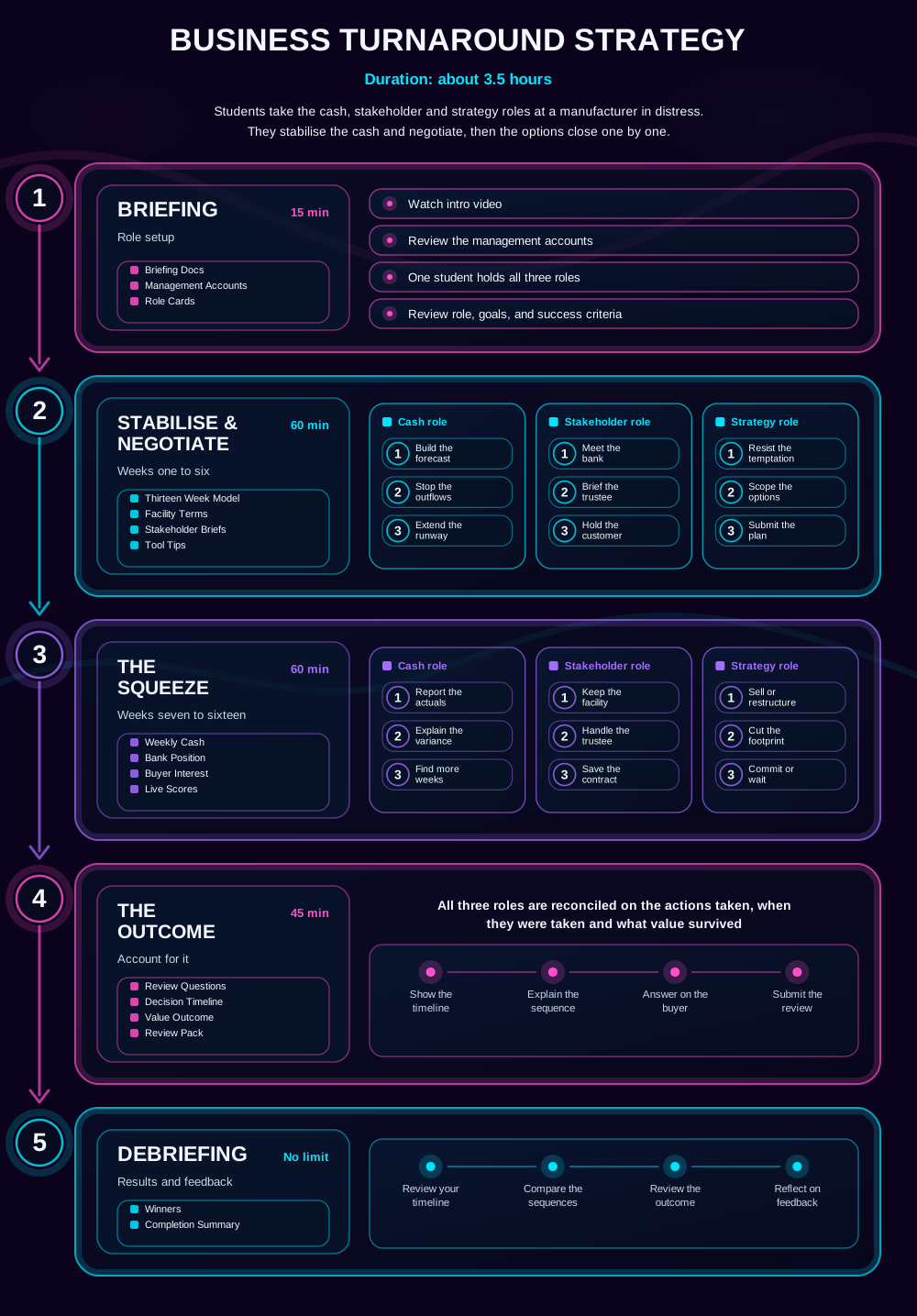
The gameflow every student sees before they start. The three roles come into play during the stabilisation and the squeeze; briefing, the outcome and the debrief are worked as a single view. Materials arrive stage by stage: management accounts and role cards at briefing, then the thirteen-week model, facility terms and stakeholder briefs for the first weeks, then the weekly cash, bank position and buyer interest once the squeeze starts.
Students produce a thirteen-week forecast the people funding it will actually believe, and extend the runway by every means available before anything else.
Students deal with a bank that can withdraw a facility, a pension trustee with a claim and a customer who is half the revenue, each able to end the business.
Students decide what the company should be once it survives, which is the most interesting question and the one that must not be answered first.
Five stages. Students stabilise a business with nineteen weeks of cash, negotiate with three stakeholders, and watch the options close.
Briefing Docs · Management Accounts · Role Cards
Briefing
Students watch the intro video, review management accounts that have been late and optimistic for two quarters, and take on all three roles, checking the facility terms, the pension position and the success criteria before any action is taken.
Thirteen Week Model · Facility Terms · Stakeholder Briefs · Tool Tips
Stabilise & Negotiate
The first six weeks run. Working as cash, the student builds a thirteen-week forecast and takes the actions that extend the runway; as stakeholder, meets a bank considering withdrawal, a pension trustee owed money and a customer who has heard rumours; as strategy, scopes the options without acting on any of them yet.
Weekly Cash · Bank Position · Buyer Interest · Live Scores
The Squeeze
Ten weeks run. A buyer appears in week eight and will not wait past week twelve, the bank wants a monitoring accountant appointed, and the first forecast missed by nine per cent, which costs more credibility than the money did. Each week that passes removes an option whether or not a decision is taken.
Review Questions · Decision Timeline · Value Outcome · Review Pack
The Outcome
The outcome is reported. Students are asked when they first took an action, which option closed first and whether they noticed, what the missed forecast cost in credibility, and whether the value preserved for stakeholders was better than a week-two solvent sale would have produced.
Winners · Completion Summary
Debriefing
Students review their own timeline, compare sequences across the cohort, revisit the outcomes that separated them and reflect on the feedback. Winners and the completion summary give you a structure for the discussion.
The student interface carries the cash forecast, the actions and the reasoning. The professor panel carries the timeline, the controls and every individual turnaround.
Students work action by action, with the cash it releases, the weeks of runway it buys and whose consent it needs side by side, and a written reason required for every action taken before the forecast is signed.
The options column is the one that matters. Eleven courses of action existed in week two and four remain in week ten, and most of them closed without anybody choosing to close them.
Your view. Adjust any stage timing, start or stop the session, and see in which week each student first did something.
Explore the student and professor experience, and discuss timing, setup and syllabus fit.
It works best as the session that teaches sequence rather than strategy.
A cash flow statement. Short-term forecasting, stakeholder negotiation and insolvency triggers are explained inside the activity.
Late module, typically weeks eight to twelve.
Debt restructuring, insolvency processes, distressed investing, change management, and any assessment asking students to produce a recovery plan.
The turnaround course guide sets out where it sits in a full module.
The three mistakes students make on this case, and what each one gives you in the debrief. Our simulations are designed around them: read the learning science behind it.
1
Fixing the business is the interesting problem and the one that must come fourth. A good plan is worthless if the company does not reach the quarter it starts in, and the students who redesign the product range in week two are usually insolvent by week fourteen.
2
A thirteen-week forecast that misses by nine per cent costs more than the cash involved, because every subsequent number is discounted. Credibility is the currency in a turnaround and the first forecast is where it is earned or spent.
3
The buyer who appears in week eight will not wait past week twelve, and holding out for a higher price removes the option entirely. Students consistently underestimate how fast the option set shrinks when nothing is being decided.
The debrief runs itself. Every student sees their results, the cohort comparison and the decisions that produced them, with nothing for you to prepare. If you would rather lead the discussion, these questions work straight from a slide, and they use what your cohort actually did.
Assessment is optional. Run the simulation ungraded as an applied activity, or use platform data as supporting evidence. Every student generates a cash forecast, dated actions, stakeholder negotiations, an outcome and written rationales. Because the simulation is single-player, every input belongs to one named student, so there is no group-work marking to untangle. All of it exports as CSV or PDF, per student, so you can assess reasoning rather than a result.
On generative AI: written rationales are exactly what marking teams now worry about. Because every rationale here is timestamped against the week it was written inside the platform, the reasoning can be checked against the evidence rather than taken on trust.
93% of students rate Finsimco simulations Excellent, across more than 30,000 responses.
Teaching notes, a setup and facilitation guide and a gameflow diagram come with it, and we support your first delivery directly.
Run it ungraded the first time. Assessment is optional and can be added once you have seen how your cohort responds.
Pause or stop at any point and resume later without losing submitted data, so an overrun costs you a timetable slot, not the activity.
Read what lecturers say.
Ron Tuninga, Managing Director for EMEA at AACSB, and Victor Hedenberg, Membership Director at AMBA, on why simulation-based learning belongs in business education. Watch both interviews.
If this one is not quite right for your module, these are the closest alternatives.
A one-page summary of this simulation, covering stages and timings, roles, concepts, learning outcomes and the debrief questions, plus a full sample teaching pack from one of our live simulations, so you can see exactly what you would be running.
During the call, we can:


