Duration
About 4 hours
You set every stage timing from the professor panel, so it fits one block or splits across two sessions.
Capital Markets Simulation
The Finsimco Capital Markets Simulation gives each student a company coming to market. They set a price range, read the order book as it fills, strike a price and allocate the deal, then watch the first week of trading judge it.
Duration
You set every stage timing from the professor panel, so it fits one block or splits across two sessions.
Format
Each student holds the valuation, syndicate and aftermarket roles in turn and submits one deal.
Level
Adjustable: a clean book in a calm market, up to a wobbling comparable, inflated demand and a broken aftermarket.
Professor tools
Manage students, adjust stage timings, control progression and monitor individual inputs.
Prerequisites
Students need to read an earnings multiple. Book-building, allocation and the greenshoe are taught inside the activity.
Delivery
The web-based simulation supports in-person, remote, blended and homework-supported delivery.
Assessment
Every submission is individual, so the range, the book, the allocations and the review answers export per student.
Course fit
Designed for Capital Markets, Investment Banking, Corporate Finance, Securities Markets and Equity Markets courses.
The topics a capital markets module has to cover: valuing a company for a new issue, book-building and price discovery, the IPO discount and underpricing, allocation and the shareholder register, the greenshoe and stabilisation and what a syndicate is for.
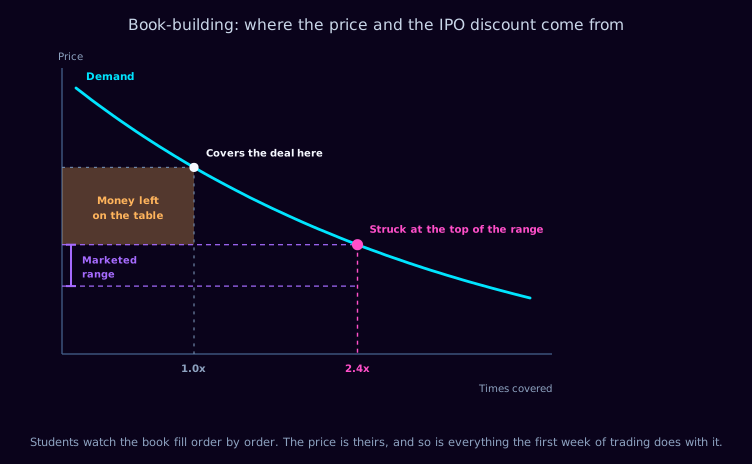
The book is a demand curve: investors will take more shares at a lower price, so the deal could be struck anywhere along it. Strike where the book just covers and the register fills with buyers who have no reason to hold. Strike below that and the discount buys aftermarket support, at a cost the issuer can see printed on day one. The IPO discount is the price of that support, and the whole judgement is where on the curve to stand.
Written to drop into your module descriptor without rewriting. On completing the simulation, your students will be able to:
Each student runs the desk alone, holding the valuation, syndicate and aftermarket roles in turn. All three want something different from the same deal, and only one price gets struck.
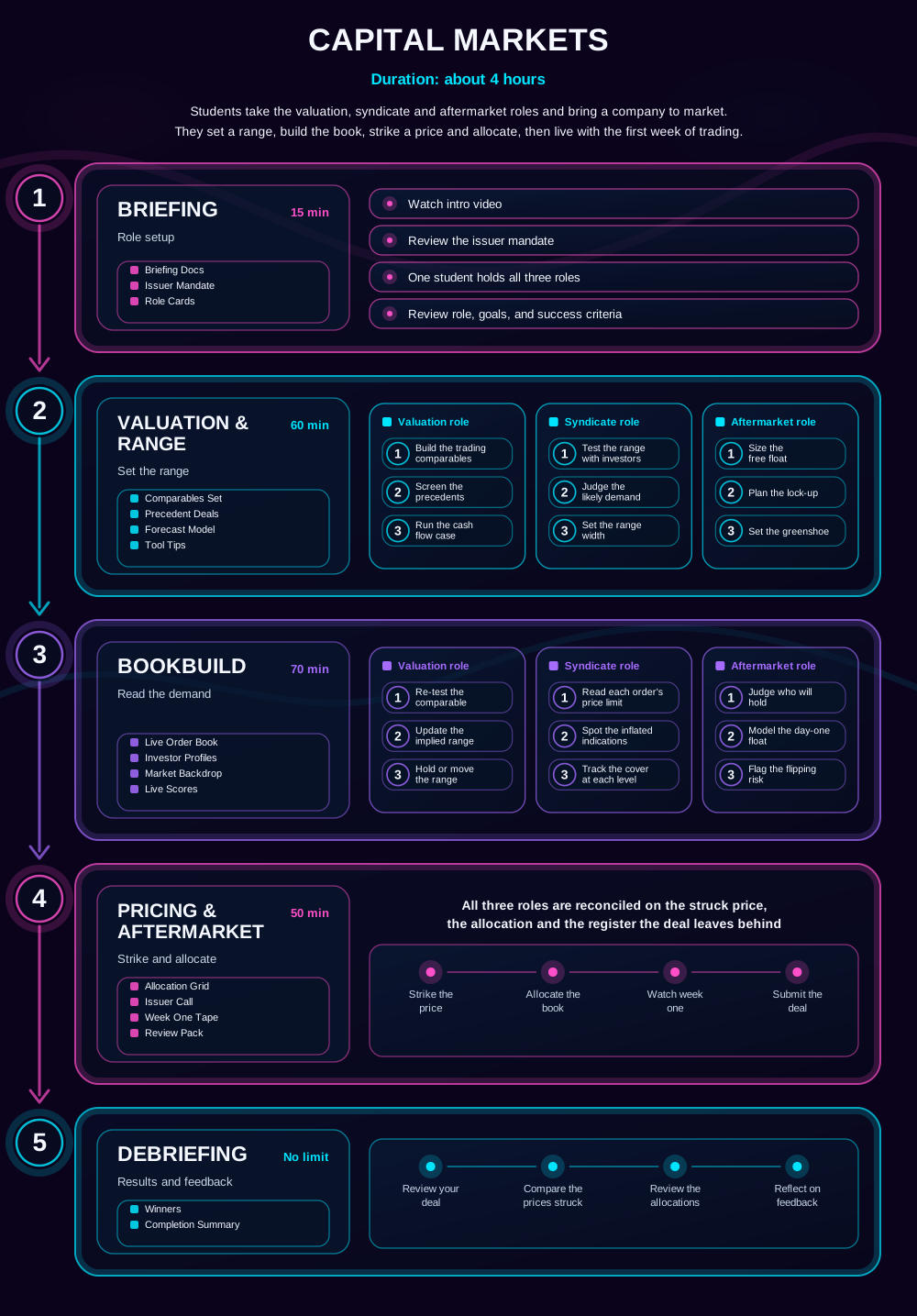
The gameflow every student sees before they start. The three roles come into play during the range and the bookbuild; briefing, pricing and the debrief are worked as a single view. Materials arrive stage by stage: issuer mandate and role cards at briefing, then the comparables set, precedent deals and forecast model for the range, then the live order book, investor profiles and market backdrop once the book opens.
Students build a value from comparable companies, precedent transactions and a discounted cash flow, then turn three ranges that disagree into one the deal can be marketed on.
Students read what each order actually means, tell price-sensitive demand from an inflated indication, and decide what the deal clears at.
Students choose who gets filled and who gets scaled back, then carry the consequence through the first week of trading and any stabilisation.
Five stages. Students value a company, market a range, watch a book fill order by order, then strike a price and find out what the first week of trading makes of it.
briefing docs · issuer mandate · role cards
Briefing
Students watch the intro video, review the issuer mandate and take on all three roles, checking what the company wants from the listing, how much is being sold and the success criteria before any valuation work begins.
comparables set · precedent deals · forecast model · tool tips
Valuation & Range
The range gets set. Working as valuation, the student builds comparables, precedents and a cash flow case that disagree; as syndicate, tests an indicative range against early investor feedback; as aftermarket, sizes the free float and the over-allotment option. The range is submitted with a written justification for its level and its width.
live order book · investor profiles · market backdrop · live scores
Bookbuild
The book fills. Orders arrive with and without price limits, a long-only fund anchors early, a hedge fund puts in an order several times the size it means, and a comparable company falls eight percent mid-week. Students watch the cover build at each level and decide what the demand is actually worth.
allocation grid · issuer call · week one tape · review pack
Pricing & Aftermarket
The deal prices. Students strike a price, allocate the book investor by investor, then watch the first week of trading: who held, who sold, whether the stock broke issue and whether the greenshoe had to be used. The issuer asks why the price was not higher.
winners · completion summary
Debriefing
Students review their own deal, compare prices and allocation approaches across the cohort, revisit the orders they believed and reflect on the feedback. Winners and the completion summary give you a structure for the discussion.
The student interface carries the valuation, the book and the reasoning. The professor panel carries the timeline, the controls and every individual deal.
Students work method by method, with the low, mid and high each approach implies sitting side by side, and a written reason required for the range taken to market and for every method given less weight.
The book is not what it looks like. A large order with no limit is a bid for allocation; a small order with a tight limit is a view on value. The cover column counts both, and only one of them will still be there in a month.
Your view. Adjust any stage timing, start or stop the session, and watch the price each student struck, how covered their book was and where the stock ended week one.
Explore the student and professor experience, and discuss timing, setup and syllabus fit.
It works best once students can build a multiple and need to see what happens when a market is asked to accept one.
Earnings multiples and the idea of a comparable company. Bookbuilding, allocation, stabilisation and the greenshoe are explained inside the activity.
Mid to late module, typically weeks six to ten, once valuation has been covered and the primary market material needs somewhere to land.
Secondary offerings, rights issues, debt capital markets, market microstructure, and any assessment asking students to appraise a real listing.
The capital markets course guide sets out where it sits in a full module.
The three mistakes students make on this topic almost every time. Recognising them is usually the moment the subject lands, and it is the core of the learning science behind it.
1
Four times covered reads as four times the demand, so the instinct is to take the money. Much of that book is not real at the top of the range, and the orders that are real are the ones that will not chase. Students who maximise the strike usually watch the stock break issue in week one, which is the fastest route into why the discount exists.
2
A large order with no price limit is often a bid for allocation, not a view on value. A small order with a tight limit is usually the opposite. Cohorts consistently fill the loudest book and are surprised when it sells on day two, and that is the moment price-sensitive demand stops being an abstraction.
3
Having set the price, students want the allocation to be proportionate and move on. Who gets filled is the other half of the deal: the same price with a different register trades completely differently a month later. Seeing two identical prices produce two different aftermarkets is what makes the point land.
The debrief runs itself. Every student sees their result, the cohort comparison and the decisions that produced them, with nothing for you to prepare. If you would rather lead the discussion, these five questions work straight from a slide, and they use what your cohort actually did.
Assessment is optional. Run the simulation ungraded as an applied activity, or use platform data as supporting evidence. Every student generates a valuation, a marketed range, an order book read, an allocation grid and written rationales. Because the simulation is single-player, every input belongs to one named student, so there is no group-work marking to untangle. All of it exports as CSV or PDF, per student, so you can assess reasoning rather than a result.
On generative AI: written rationales are exactly what marking teams now worry about. Because every rationale here is tied to an order the student read and a price they struck inside the platform, with the book and the week-one tape sitting next to it, the reasoning can be checked against the evidence rather than taken on trust.
93% of students rate Finsimco simulations Excellent, across more than 30,000 responses.
Teaching notes, a setup and facilitation guide and a gameflow diagram come with it, and we support your first delivery directly.
Run it ungraded the first time. Assessment is optional and can be added once you have seen how your cohort responds.
Pause or stop at any point and resume later without losing submitted data, so an overrun costs you a timetable slot, not the activity.
Read what lecturers say.
Ron Tuninga, Managing Director for EMEA at AACSB, and Victor Hedenberg, Membership Director at AMBA, on why simulation-based learning belongs in business education. Watch both interviews.
If this one is not quite right for your module, these are the closest alternatives.
A one-page summary of this simulation, covering stages and timings, roles, concepts, learning outcomes and the debrief questions, plus a full sample teaching pack from one of our live simulations, so you can see exactly what you would be running.
During the call, we can:


