Duration
About 3.5 hours
You set every stage timing from the professor panel, so it fits one block or splits across two sessions.
Basel Regulations Simulation
The Finsimco Basel Regulations Simulation makes each student treasurer of a bank holding thirteen point one per cent of capital against a requirement of eleven point eight. The distribution restriction is the part nobody mentions until it applies.
Duration
You set every stage timing from the professor panel, so it fits one block or splits across two sessions.
Format
Each student holds the capital, risk weight and distribution roles in turn and submits one capital plan.
Level
Adjustable: one capital ratio on fixed risk weights, up to the full stack, a raised buffer and a stress test.
Professor tools
Manage students, adjust stage timings, control progression and monitor individual inputs.
Prerequisites
Students need to know what a bank balance sheet is. Risk-weighted assets, tiers and buffers are taught inside.
Delivery
The web-based simulation supports in-person, remote, blended and homework-supported delivery.
Assessment
Every submission is individual, so the capital plan, the distribution policy and the review answers export per student.
Course fit
Designed for Banking, Financial Regulation, Risk Management, Financial Institutions and Public Policy courses.
The topics a basel regulations module has to cover: risk-weighted assets and risk weight density, common equity tier 1 and the capital tiers, the conservation and countercyclical buffers, the systemic surcharge and Pillar 2, the distribution restriction and headroom and the leverage ratio backstop.
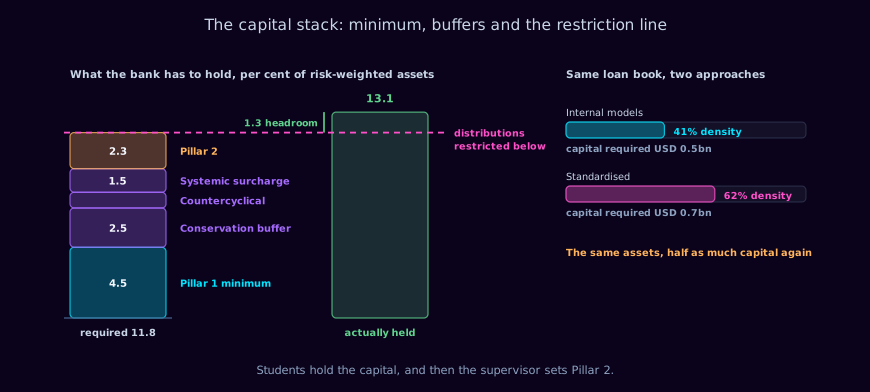
The capital stack built from the bottom: four and a half per cent minimum, two and a half conservation buffer, one countercyclical, one and a half systemic surcharge and two point three set by the supervisor, giving eleven point eight. The bank holds thirteen point one, so the headroom is one point three. The line across the stack is where distributions start to be restricted by formula, which is why banks manage to a headroom rather than to the requirement. Beside it, two banks with the same loan book carry risk-weighted assets of forty-one and sixty-two per cent of total assets.
Written to drop into your module descriptor without rewriting. On completing the simulation, your students will be able to:
Each student runs the treasury alone, holding the capital, risk weight and distribution roles in turn. All three want something different from the same balance sheet, and only one plan is approved.
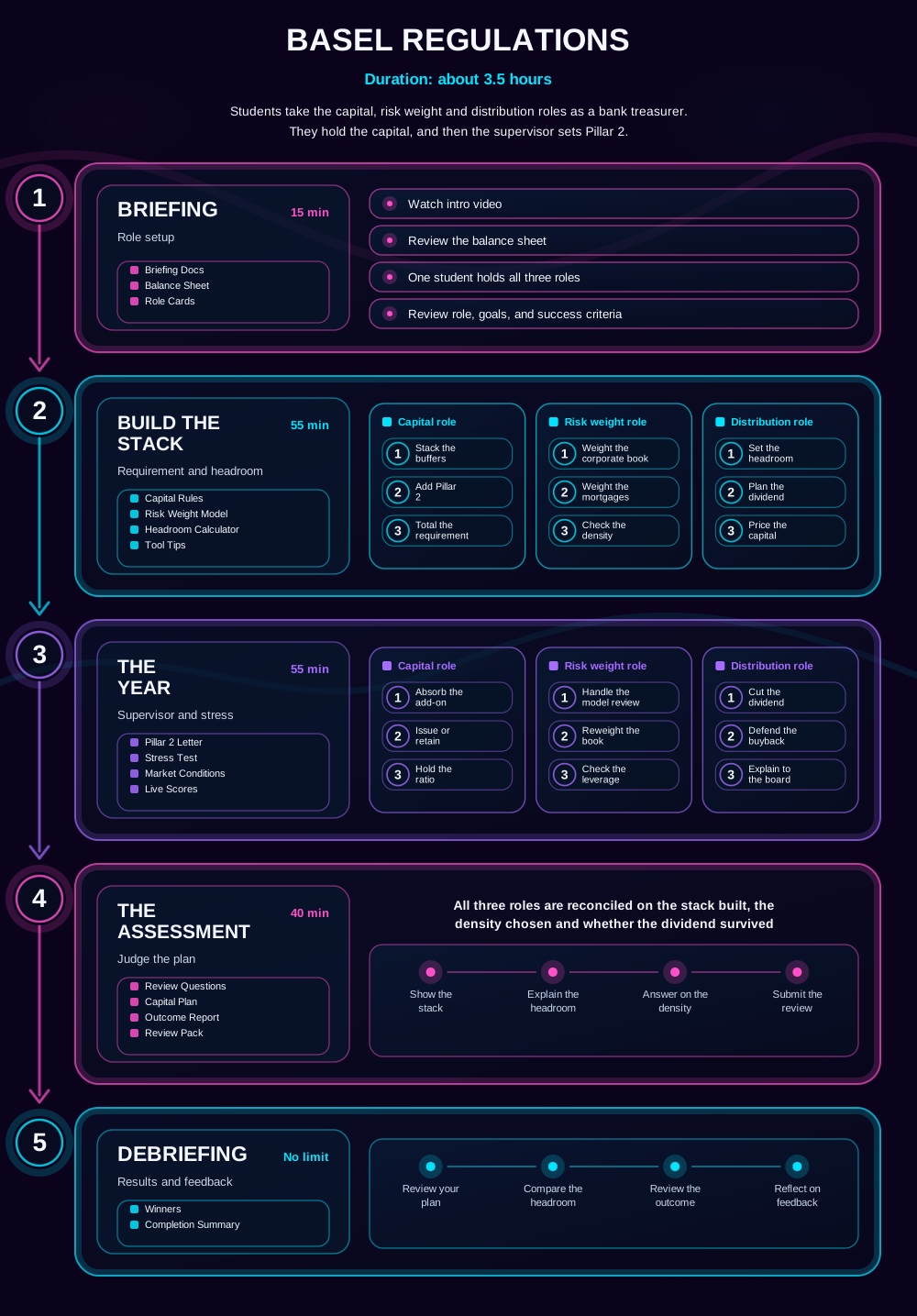
The gameflow every student sees before they start. The three roles come into play while the stack is built and through the year; briefing, the assessment and the debrief are worked as a single view. Materials arrive stage by stage: balance sheet and role cards at briefing, then the capital rules, risk weight model and headroom calculator, then the Pillar 2 letter, stress test and market conditions.
Students build the requirement layer by layer, from the minimum through the conservation, countercyclical and systemic buffers to the supervisor's own addition.
Students decide how assets are weighted, which is where two banks with identical loan books end up holding very different amounts of capital.
Students choose how far above the requirement to run, because falling into the buffer region limits dividends and bonuses by formula rather than by choice.
Five stages. Students build the capital stack, set the headroom and carry it through a stress test.
Briefing Docs · Balance Sheet · Role Cards
Briefing
Students watch the intro video, review a bank with ninety billion dollars of assets, a mixed corporate and mortgage book and a board expecting a dividend, and take on all three roles, checking the current ratios and the success criteria before any plan is set.
Capital Rules · Risk Weight Model · Headroom Calculator · Tool Tips
Build the Stack
The stack is built. Working as capital, the student assembles the requirement layer by layer; as risk weight, decides between internal models and the standardised approach and watches the density move; as distribution, sets a headroom knowing that capital is expensive and that falling below the line stops the dividend.
Pillar 2 Letter · Stress Test · Market Conditions · Live Scores
The Year
A year runs. The supervisor raises the Pillar 2 requirement by eighty basis points, the countercyclical buffer is raised, a model approval is questioned so part of the book reverts to standardised weights, and a stress test shows the bank falling into the buffer region in the adverse scenario.
Review Questions · Capital Plan · Outcome Report · Review Pack
The Assessment
The plan is assessed. Students are asked what headroom they carried and what it cost, how much of their requirement came from the supervisor rather than the rules, whether the leverage ratio or the risk-weighted requirement bound first, and whether the dividend survived the stress test.
Winners · Completion Summary
Debriefing
Students review their own capital plan, compare headroom and densities across the cohort, revisit the decisions that separated them and reflect on the feedback. Winners and the completion summary give you a structure for the discussion.
The student interface carries the stack, the densities and the headroom. The professor panel carries the timeline, the controls and every individual capital plan.
Students work layer by layer, with each requirement, the running total and the distance to the restriction line side by side, and a written reason required for the headroom chosen.
The stress column is the one that decides the dividend. The bank clears the requirement in the base case and falls into the buffer region in the adverse one.
Your view. Adjust any stage timing, start or stop the session, and compare the headroom each student carried with whether their dividend survived.
Explore the student and professor experience, and discuss timing, setup and syllabus fit.
It works best as the session that makes a regulation behave like a constraint.
What a bank balance sheet is. Risk-weighted assets, capital tiers and buffers are explained inside the activity.
Mid to late module, typically weeks six to eleven, once banking basics are covered.
Resolution and recovery planning, liquidity requirements, supervisory review, macroprudential policy, and any assessment asking students to evaluate a bank's capital position.
The Basel course guide sets out where it sits in a full module.
The three mistakes students make on this case, and what each one gives you in the debrief. Our simulations are designed around them: read the learning science behind it.
1
Four and a half per cent is the number in the headline and no bank in the world runs anywhere near it. The number that governs behaviour is the one below which the dividend is restricted by formula, and it is seven points higher.
2
Two banks with the same loan book can carry densities of forty-one and sixty-two per cent depending on how the assets are modelled, which is a difference of half as much capital again. Students accept the denominator and argue about the numerator.
3
Capital is the most expensive funding a bank has, so every point of headroom has a cost that shows up in return on equity. Students either run too thin and lose the dividend in the stress test, or too thick and cannot explain the return.
The debrief runs itself. Every student sees their results, the cohort comparison and the decisions that produced them, with nothing for you to prepare. If you would rather lead the discussion, these questions work straight from a slide, and they use what your cohort actually did.
Assessment is optional. Run the simulation ungraded as an applied activity, or use platform data as supporting evidence. Every student generates a capital stack, density decisions, a headroom target, a distribution plan and rationales. Because the simulation is single-player, every input belongs to one named student, so there is no group-work marking to untangle. All of it exports as CSV or PDF, per student, so you can assess reasoning rather than a result.
On generative AI: written rationales are exactly what marking teams now worry about. Because every rationale here is tied to a stack the student built inside the platform before the supervisor's letter arrived, the reasoning can be checked against the evidence rather than taken on trust.
93% of students rate Finsimco simulations Excellent, across more than 30,000 responses.
Teaching notes, a setup and facilitation guide and a gameflow diagram come with it, and we support your first delivery directly.
Run it ungraded the first time. Assessment is optional and can be added once you have seen how your cohort responds.
Pause or stop at any point and resume later without losing submitted data, so an overrun costs you a timetable slot, not the activity.
Read what lecturers say.
Ron Tuninga, Managing Director for EMEA at AACSB, and Victor Hedenberg, Membership Director at AMBA, on why simulation-based learning belongs in business education. Watch both interviews.
If this one is not quite right for your module, these are the closest alternatives.
A one-page summary of this simulation, covering stages and timings, roles, concepts, learning outcomes and the debrief questions, plus a full sample teaching pack from one of our live simulations, so you can see exactly what you would be running.
During the call, we can:


